From the notebook
Advanced Learning Techniques
Two lists from a Brian Tracy course, and what I make of them now.
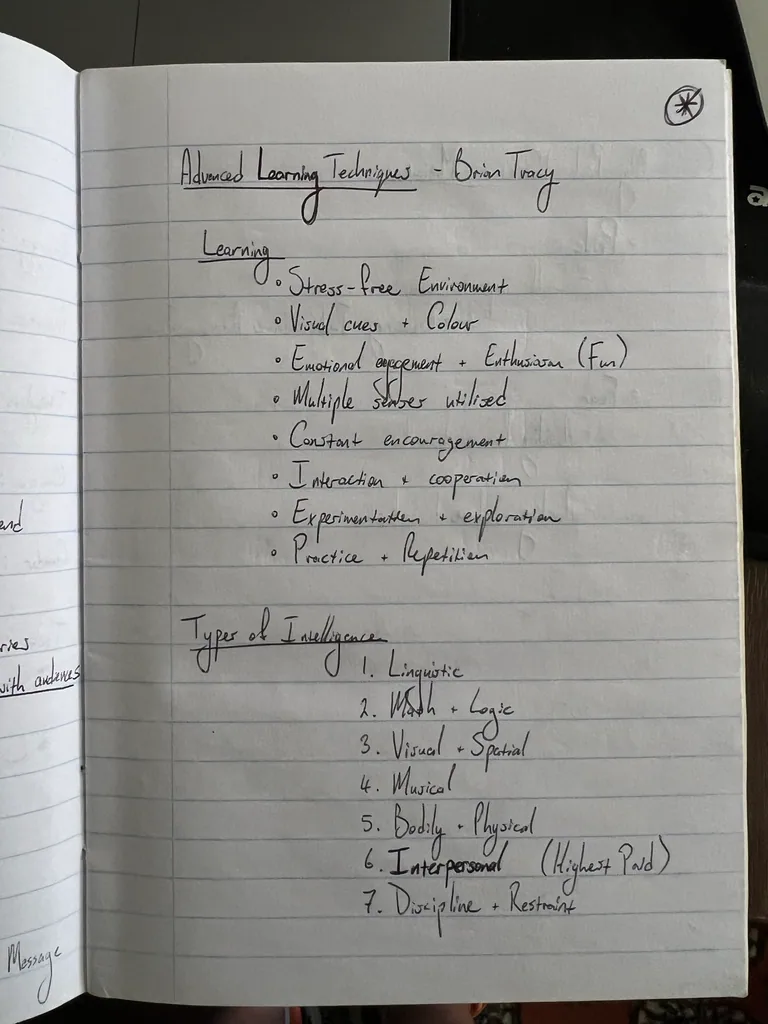
I was flipping through an old notebook and found this page. Notes from a Brian Tracy course on learning. Two lists: what a good learning environment needs, and the different types of intelligence.
It’s a short page, but it’s aged pretty well. So here it is, typed up, with a few notes from me.
Note: I’m fairly sure the course is actually called Accelerated Learning Techniques. Past me wrote Advanced. I’ve kept his title.
List one
Eight conditions for learning
Tracy’s first list is about the setting. Get these right and you learn faster, without trying any harder. Here they are in the order I wrote them down.
- Stress-free environmentIt’s hard to take anything in when you’re anxious. Take the pressure off first.
- Visual cues + colourDiagrams, highlighters, colour-coded notes. We remember pictures far better than paragraphs.
- Emotional engagement + enthusiasmIf you care about something, it sticks. Tracy put fun on the list, so fun counts.
- Multiple senses utilisedRead it, say it out loud, draw it, build it. Each extra sense is another hook for the memory.
- Constant encouragementFrom a teacher, a friend or yourself. Small wins keep you coming back.
- Interaction + cooperationExplaining something to someone else is one of the fastest ways to find out what you don’t know yet.
- Experimentation + explorationPoke at it and see what happens. You learn where the edges are by finding them yourself.
- Practice + repetitionNothing sticks without it. Do it again, then do it again next week.
Try it on your last study session
Think about the last time you sat down to learn something properly. Which of these did you have?
0/8
Tap the ones you had.
NB: Read that list again with VR in mind. Visual cues, multiple senses, interaction, exploration. Half of it reads like the brief for a good VRChat world.
List two
Seven types of intelligence
This one comes from Howard Gardner’s theory of multiple intelligences, from his 1983 book Frames of Mind. Gardner’s idea is that everyone has all of them, in different amounts. You learn fastest when you lean on your strong ones.
Map your own
Rate yourself from 1 to 5 on each. No one’s marking it.
Two of these deserve a closer look.
6. Interpersonal (highest paid)
That note in brackets is Tracy’s, not mine. His claim is that the ability to get along with, understand and persuade other people earns more than any of the others. Most of my work has been a team effort, so I’m not about to argue.
7. Discipline + restraint
Gardner calls this one intrapersonal: knowing yourself, your moods and your motives. Tracy frames it as self-control. Knowing what you should do is the easy part. Doing it, and not doing the other thing, is where this one comes in.
That’s all, folks
If you only take one thing from this page, take the first list. Next time you sit down to learn something, check how many of the eight you’ve got going. Add one.
Virtually yours,
Deac