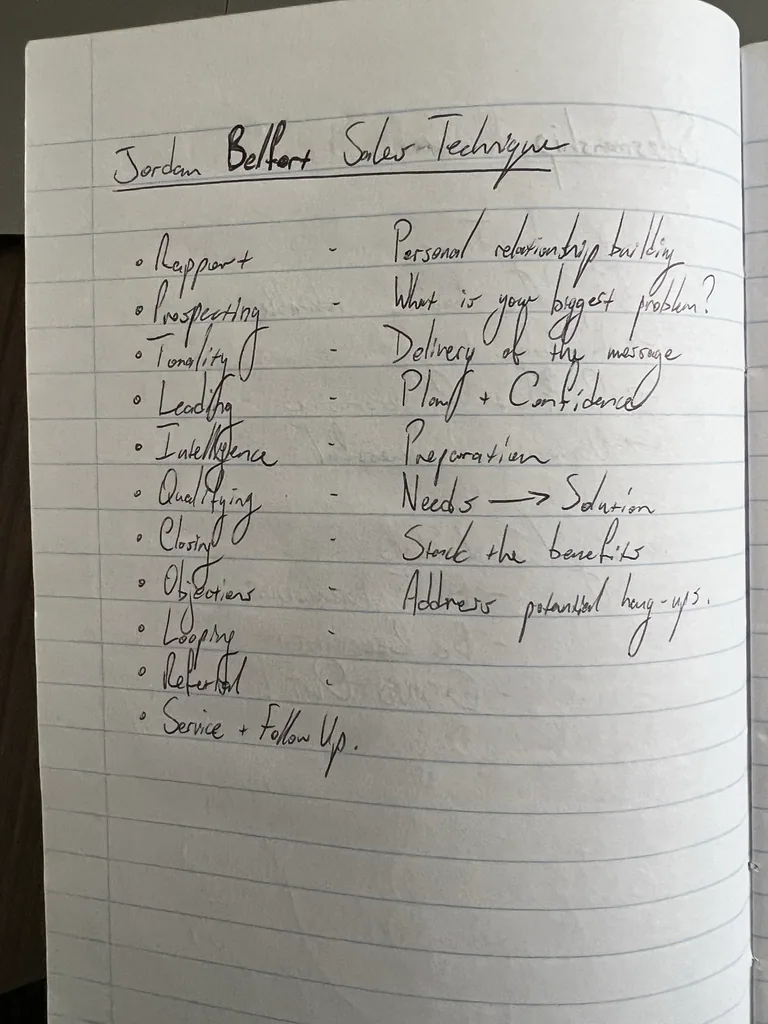
Rapport
People buy from people they like and trust, so the first job is to be someone they like and trust. Find something you genuinely have in common and talk about it like a person, not a pitch.
Belfort says you have about four seconds to come across as sharp, enthusiastic and an expert. That first impression does most of the work here.
Prospecting
The whole step fits in one question, and I wrote it down word for word:
What is your biggest problem?
Then you shut up and listen. Their answer tells you whether they’re worth your time, and it hands you everything you’ll need later in qualifying and closing.
Tonality
Delivery of the message. How you say it matters as much as what you say. Take the question from step two and move the stress around:
- What is your biggest problem?Not the industry’s. Yours.
- What is your biggest problem?Skip the small stuff.
- What is your biggest problem?I’m here to fix something, not chat.
Same words, three different questions. Pick the one you mean before you open your mouth.
Leading
Plan and confidence. You decide where the conversation goes, and you go there like you’ve done it a hundred times. If you sound unsure about the next step, they won’t take it.
You walk in front. They follow because you clearly know the way.
Intelligence
Preparation. The confidence from step four has to come from somewhere, and this is where. Before the call:
- Know who they are and what their business does.
- Know your product better than anyone they’ll talk to this week.
- Guess the questions they’ll ask, and have the answers ready.
- Know where you want the conversation to end up.
Qualifying
This is where you join their problem to your product. Take what they told you in prospecting, and show how what you’re selling solves it, one need at a time.
If you can’t draw that arrow for a need, don’t pretend you can. Not every prospect is a fit, and it’s fine to find that out here.
Closing
Stack the benefits. Don’t lean on one big reason. Lay them down one at a time, each a little heavier than the last, until saying no feels like it needs more effort than saying yes.
- It solves the problem you told me about
- It saves you time
- It’s already worked for people like you
- Yes
Objections
Address potential hang-ups. The first close almost never lands. You’ll usually hear one of these:
- “Let me think about it.”
- “It’s a bit expensive.”
- “Send me some info.”
- “I need to check with my partner.”
Most of the time these aren’t real reasons. They’re a polite way of saying “I’m not sure yet.” Which is exactly what the next step is for.
Looping
The page goes blank from here, so this is from memory. Looping is how you handle the objection. Don’t argue with it. Acknowledge it, go back up the line, and sell again with a bit more certainty than last time.
Belfort says a buyer needs to be certain of three things before they say yes. He scores them out of ten:
- The product
- 10
- You
- 10
- Your company
- 10
Each loop is a chance to push one of those up a notch. Find the one that’s low, work on that, then close again.
Referral, Service + Follow Up
The last two are also blank, but they don’t need much. Once they’ve said yes, ask who else they know with the same problem. Then look after them properly and keep checking in.
A happy client is your rapport for the next sale already done. Someone they trust has vouched for you before you’ve said a word, which puts you back at the top of the line with a head start.