Left brain
The checker
- Alertness
- Critical thinking
- Social rules
- Self-awareness
- Verbal + logical
From the notebook
And the way around critical thinking.
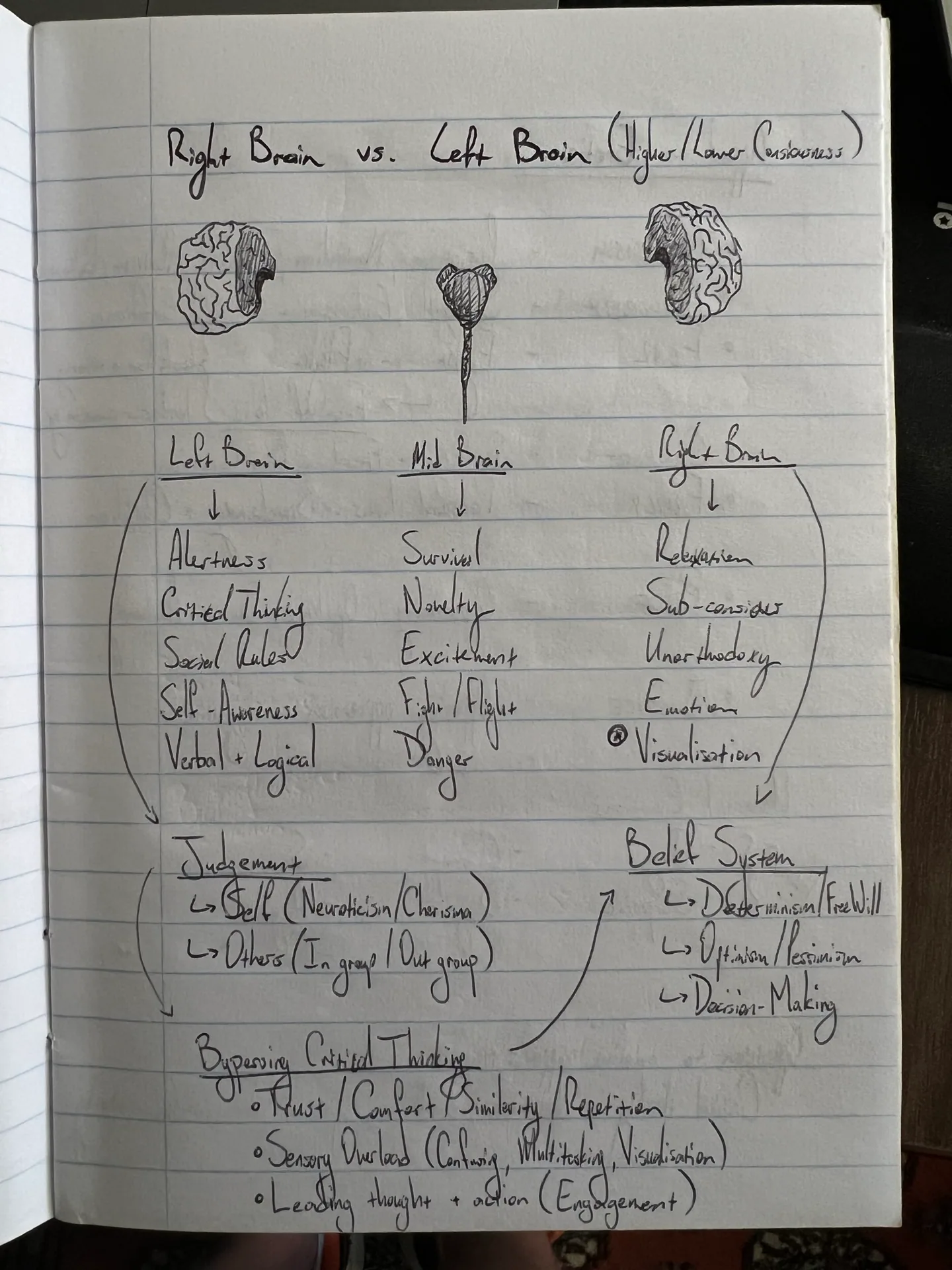
This page is from an old notebook. Three brains, five words under each, and a few arrows trying to explain why some ideas get past us without a fight.
The neuroscience is pop-science. Your hemispheres don’t split the work this neatly, and nobody is purely “left-brained”. But as a rough model of how people get persuaded, it’s pretty good. Here it is, cleaned up.
 Open the full-size page
Part one
The checker
The alarm
The believer
Alertness, critical thinking, social rules, self-awareness, the verbal and the logical. This is the part of you that reads the small print. It’s slow, it’s sceptical, and it’s the voice doing the talking in your head.
Everything it does runs down into judgement, and the page splits judgement two ways.
Judging yourself
NeuroticismCharisma
Judging others
In-groupOut-group
Too hard on yourself and you’re anxious. Easy on yourself and you come across as charismatic. Point it outward and it sorts people into us and them, fast.
Survival, novelty, excitement, fight or flight, danger. It’s older than the other two and a lot faster. It doesn’t check anything. Something new or something threatening gets its attention first, and the rest of you catches up later.
On the page it’s the only column with no arrow coming out of it. It just sits in the middle, switched on.
Relaxation, the subconscious, unorthodoxy, emotion, visualisation. This side doesn’t argue. It pictures things, feels them and takes them on board.
Its arrow runs down to the belief system, the stuff you don’t re-check every morning.
Who’s in control?
DeterminismFree will
How will it go?
OptimismPessimism
Which adds up to
Decision-making
Whether you think your life is yours to steer, whether you expect it to go well, and so how you make decisions. Change someone’s beliefs and you’ve changed what they’ll choose without arguing about any single choice.
Part two
This is what the arrows are really about. The left brain blocks a lot. A claim comes in, gets checked, gets judged. Wrong tribe, weak argument, no sale.
But there’s a second arrow on the page. It runs from the bottom left, up and around to the belief system, and it’s labelled Bypassing Critical Thinking. There are three ways listed. Try them.
We check strangers. We don’t check friends nearly as hard. Someone who looks like you, talks like you, or who you’ve simply seen a hundred times gets waved through. Repetition is the cheap version of this. Say something often enough and it starts to feel familiar, and familiar starts to feel true.
Confusion, multitasking, visualisation. Give the checker too much at once and it can’t keep up. Fast talk, a busy screen, three things happening at the same time. The details slip past while it’s dealing with the noise.
Visualisation shows up twice on the page: once as a right-brain trait, and once here, as a way in. Get someone to picture it and you’re already talking to the side that believes.
The note just says “engagement”. Get someone thinking along with you, then doing something small. Nodding, answering, clicking, trying it on. Each step is tiny, so none of them gets judged on its own, and by the time the checker looks up they’re already most of the way there.
Part three
Written out like this, it reads like a con artist’s manual. It can be. It’s also how a good teacher, a good story or a good game works. Nobody learns much while they’re on guard.
It’s handy from the receiving end too. If a pitch feels oddly comfortable, or there’s a lot going on at once, or you’ve said yes three times without noticing, that’s a good moment to slow down and let the left brain have a look.
I build VR worlds now, and I can’t read that second bullet without thinking of a headset. Sensory overload, visualisation, engagement. That’s most of what VR does to you, which is a good reason to be careful with it.