From the notebook
Sixteen Is Too Few
Myers-Briggs, a page of scribbles, and some maths I got wrong.
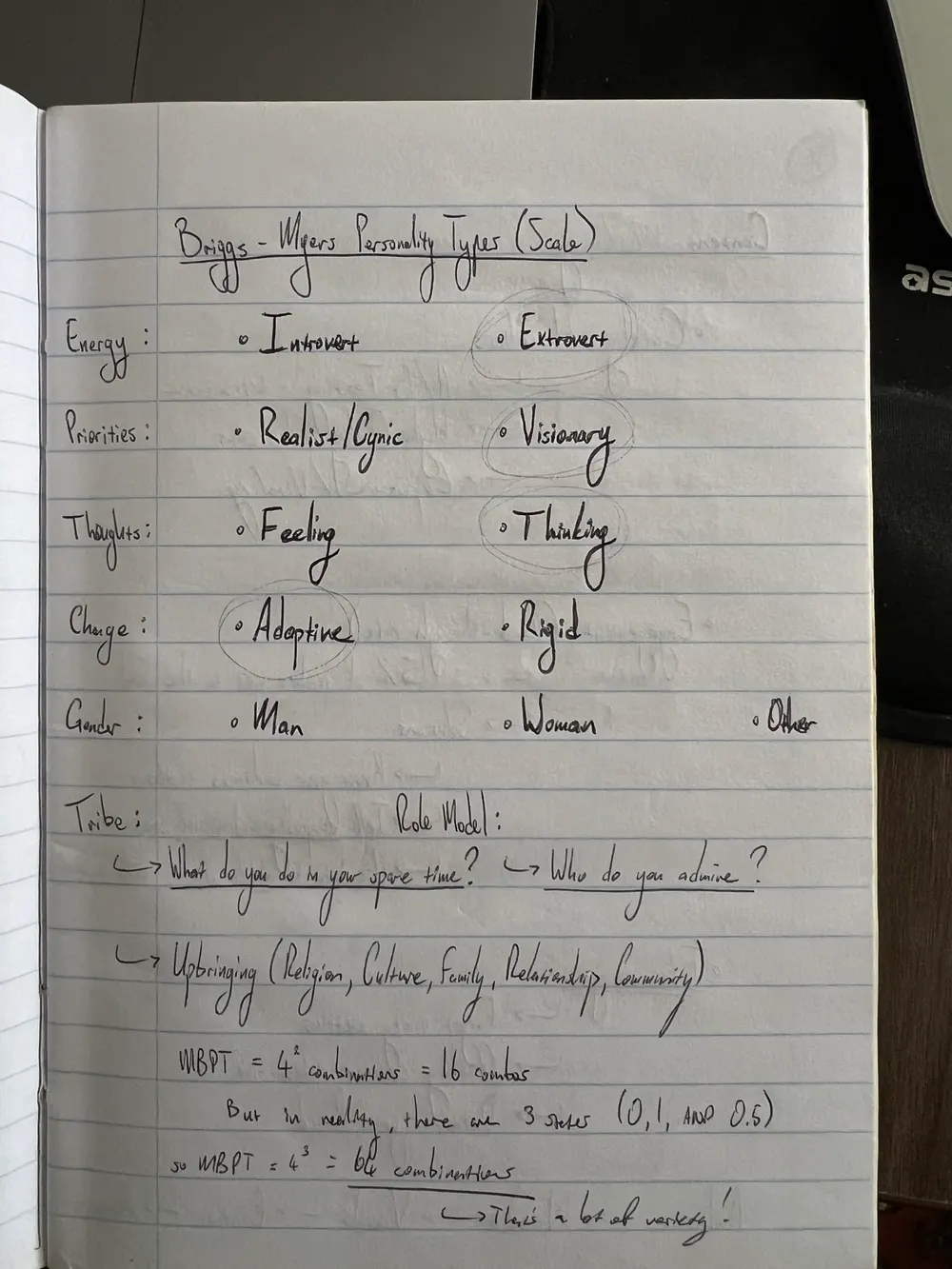
This is a page from my notebook. I wanted a quick way to sketch a person, so I started with the Myers-Briggs personality types and wrote them out as a scale.
You might spot “Briggs-Myers” at the top. It’s Myers-Briggs. Katharine Cook Briggs and her daughter, Isabel Briggs Myers, built it in the 1940s on top of Carl Jung’s ideas about psychological types.
I renamed the four pairs in my own words, then tried to count the combinations. I got the maths wrong twice. Let’s fix that.
The four pairs
Myers-Briggs sorts you on four pairs, and each one gets a letter. Here are my names for them next to the official ones.
- EnergyI IntrovertE Extrovert
- PrioritiesS RealistN Visionary
- ThoughtsF FeelingT Thinking
- ChangeP AdaptiveJ Rigid
The circles are mine. Extrovert, visionary, thinking, adaptive. In Myers-Briggs letters, that makes me an ENTP.
My labels are a bit blunter than the official ones. Myers-Briggs calls the realist side Sensing (trusting what’s in front of you) and the visionary side Intuition (chasing patterns and possibilities). “Rigid” is my word for Judging, which really just means you like a plan and you like it settled. Perceiving is the opposite: keep your options open and adapt as you go.
Build one
Each pair is a switch. Flip all four and you land on one of sixteen types. Then let people sit in the middle and see what happens to the grid. A middle setting shows up as an X, which is how some people write it (ENXP, for example).
Your type: ENTP
Extrovert · Visionary · Thinking · Adaptive
16 possible types
Fixing my maths
In the notebook I wrote “MBPT = 4² = 16”. The answer’s right, but the sum isn’t (and it’s MBTI, the Myers-Briggs Type Indicator).
Four pairs with two choices each is 2 × 2 × 2 × 2. That’s 2⁴, not 4².
Then I added a middle setting: 0, 1, and 0.5 for anyone who sits on the fence. I wrote 4³ = 64. It should be three choices, four times. 3⁴.
- 2⁴16Just the ends
- 3⁴81With the middle
- 3⁴ × 3243Add gender
Eighty-one. Even more variety than I thought.
I think the middle setting is a fair addition. Most people don’t score at the far ends of these pairs. They bunch up somewhere in between. That’s one of the main criticisms of Myers-Briggs: it takes a sliding scale and forces it into one of two boxes. The Big Five model, which psychologists tend to prefer, keeps each trait as a scale.
Gender sits on the page as its own question. Man, woman or other. Three more options, so 81 × 3 = 243.
The parts no quiz covers
The bottom half of the page is where it gets interesting. These don’t fit on a scale. They’re open questions, and there are as many answers as there are people.
- TribeWhat do you do in your spare time?
- Role modelWho do you admire?
- UpbringingWhere do you come from?ReligionCultureFamilyRelationshipsCommunity
Two ENTPs with identical scores can still be very different people. One spends weekends hiking, the other builds VRChat worlds. One grew up in a big religious family, the other was raised by a single parent in a new city. The four letters won’t tell you which.