Part I
Introduction
Overview
“Computer science is no more about computers than astronomy is about telescopes.” — Edsger Dijkstra
The end of Moore’s Law is a controversial topic that invites much debate. One interpretation of such a moment in time heralds an era of further and faster technological progress. Contradictory interpretations of the same event view it as an early indicator of technological stagnation. These two contrasting narratives provide the foundation upon which many of us might contextualize the long-term future of culture, industry, and governance.
In this series, we empirically examine the state of Moore’s Law at present.
By leveraging public domain lithographic data, we plot the progression of Moore’s Law from its inception to the present day. This investigation concludes that Moore’s Law is still in effect.
Transistor gates have decreased in size reliably, as Moore’s Law predicted, but this trend has run into increasing resistance. However, processor speeds continue to rise exponentially through an increase in transistor density.
3D chip architectures are replacing the traditional 2D chip architecture to which Moore contributed. Lithographic component size is being replaced by the transistor density metric, facilitating a new paradigm in computational efficiency. This suggests that a successor paradigm has superseded the classic definition of Moore’s Law. While component size will likely continue to decrease over time, the processing capability of our machines will continue to grow at a rapid rate.
The Sensation of Time
It is well-established that the subjective sensation that time speeds up as we age results from biological (Bejan, 2019) and psychological (Robison, 2016) effects. With an ever-growing frame of reference, we perceive each year as feeling quicker than the last. In the field of physics, the illusory nature of time persists. While Einstein famously redefined time and space as a single entity, Deutsch (1998) eloquently describes how a linear conception of time flowing from past to present might be a misapprehension in a universe governed by quantum effects. Later, economists and psychologists concur. Taleb (2007) showed that our perceptive faculties are regularly “fooled by randomness”, and Kahneman (2011) popularized the fact that the human mind is prone to a litany of biases and heuristics. Our subjective experiences should not be overly relied upon to inform our decision-making about the objective nature of time. If we want to be serious about understanding reality to take practical actions in the present (thereby shaping the desired future), we need to be serious about measuring what matters. Not only should empirical observations be measured, but it is equally important to discern why the data shows us what it does.
Technological Change Over Time
In 1965, Gordon Moore, in his article “Cramming more components onto integrated circuits”, famously observed that the number of transistors on an integrated circuit doubled approximately every two years (Moore, 1965). Known as “Moore’s Law”, this trend has remained remarkably reliable for over half a century. That said, Moore’s Law has never seriously claimed to resemble a mathematical constant or physical law of nature. Far from it. Some observers (Schaller, 1997 & Simonite, 2016) have argued that Moore’s Law is no more than a self-fulfilling prophecy serving primarily as a roadmap for future developments. Moore inspired a generation of engineers to consistently overcome prior chip architectures’ limitations within the semiconductor industry and adjacent industries. Even in his original article, however, Moore foresaw limits to the pattern of growth he observed. Partly in an attempt to investigate the phenomenon observed by Gordon Moore, Hans Moravec (1988), and Raymond Kurzweil (1991) independently mapped various computers’ processing capabilities throughout history. Whilst computational standards and techniques have changed over the years, metrics have been devised to compare machines from different eras.
By estimating the number of calculations (Floating point operations) that any given machine can perform per second, computers from different eras can effectively be compared in their ability to quickly and accurately process information. A cursory glance at the data would appear to show a consensus that the pace of technological change indeed takes place at an accelerating rate.
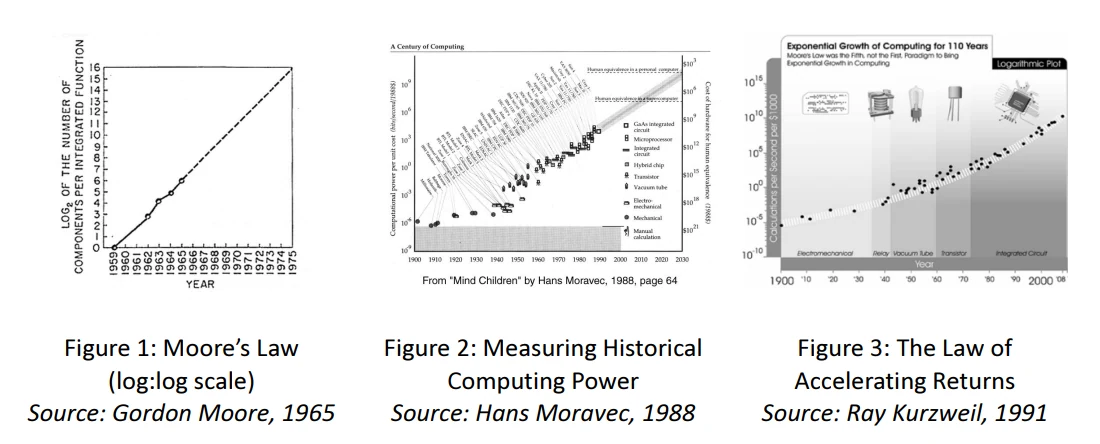
All three of the above independent analyses indicate that an exponential trend in computational capacity is in effect. However, it is essential to note that the mere existence of correlating evidence between Moore, Moravec, and Kurzweil may be coincidental. A correlation of evidence cannot logically justify an assumption that a trend will continue. As Karl Popper famously declared, the problem of induction presumes that the past will resemble the future under similar conditions. (Popper, 1963) This presumption pales in the light of modern complexity science in which initial conditions themselves are irreducibly complex. Bertrand Russell (1990) exemplified the problem of induction in his “story of the chicken”, later reinterpreted in Taleb’s (2007) “turkey problem”. Taleb succinctly explains,
Consider a turkey that is fed every day, every single feeding will firm up the bird’s belief that it is the general rule of life to be fed every day by friendly members of the human race ‘looking out for its best interests,’ as a politician would say. On the afternoon of the Wednesday before Thanksgiving, something unexpected will happen to the turkey. It will incur a revision of belief. (Taleb, 2007)
As such, we cannot rely solely upon past trends and correlating evidence to predict future events.
Whilst Moore and Moravec publicly concerned themselves with whether or not an accelerating rate of change exists, Kurzweil sought to understand why this might be the case.
It was Kurzweil who incorporated Moore’s Law into a broader explanatory theory of technological change. Over the years, The Law of Accelerating Returns has been refined over several iterations. Originally in The Age of Spiritual Machines (1999), Kurzweil stated that “As order exponentially increases, time exponentially speeds up (that is, the time interval between salient events grows shorter as time passes.” (Kurzweil, 1999). This definition was expanded upon two years later in an essay called The Law of Accelerating Returns (2001).
Kurzweil (2001) details several premises as follows,
- Evolution applies positive feedback in that the more capable methods resulting from one stage of evolutionary progress are used to create the next stage. As a result, the rate of progress of an evolutionary process increases exponentially over time. Over time, the “order” of the information embedded in the evolutionary process (i.e., the measure of how well the information fits a purpose, which in evolution is survival) increases.
- A correlate of the above observation is that the “returns” of an evolutionary process increase exponentially over time. In another positive feedback loop, as a particular evolutionary process (e.g., computation) becomes more effective (e.g., cost-effective), greater resources are deployed toward the further progress of that process. This results in a second level of exponential growth (i.e., the rate of exponential growth itself grows exponentially).
- Biological evolution is one such evolutionary process. Technological evolution is another such evolutionary process. Indeed, the emergence of the first technology creating species resulted in the new evolutionary process of technology. Therefore, technological evolution is an outgrowth of–and a continuation of–biological evolution.
- A specific paradigm (a method or approach to solving a problem, e.g., shrinking transistors on an integrated circuit as an approach to making more powerful computers) provides exponential growth until the method exhausts its potential. When this happens, a paradigm shift occurs, which enables exponential growth to continue.
Later, in The Singularity is Near (2005), he reformulated the notion:
“[The] rate of progress of an evolutionary process increases exponentially over time. Over time, the “order” of the information embedded in the evolutionary process (i.e., the measure of how well the information fits a purpose, which in evolution is survival) increases.” — (Kurzweil, 2005)
To simplify further, we could say that Kurzweil popularized the idea that technology improves at an accelerating rate of change because of evolutionary pressures.
He does so by utilizing a synthesis between notions of order, disorder, chaos, and time, concepts predominantly expounded upon in the diverse fields of physics, complexity science, evolutionary biology, and information theory. Of note, the law of accelerating returns emphasises how computational efficiency has improved both in terms of diminishing costs and increasing capability (measured in calculations per second per inflation-adjusted dollar). Much like how Moore’s Law presaged an unprecedented information age, Kurzweil (2001) reflects on the profound consequences of such a trend. In this sense, Kurzweil shaped an empirical trend-based methodology for thinking about the future. That said, in the same vein as Moore’s Law, there is a socio-economic nature to Kurzweil’s hypothesis.
At its core, it is an emergent pattern of human behaviour.
For this reason, it sits squarely in the realm of complexity theory, in which chaotic constituents within a complex dynamic system might generate predictable emergent phenomena. In essence, the approach illustrates a seemingly orderly trend from a chaotic milieu.
Whilst not having any exceptional knowledge about the future, Gordon Moore could wrestle with the implications of the trend he identified.
Similarly, Moravec and Kurzweil challenge us to contemplate novel economic, ethical, and sociopolitical changes that might result from the law of accelerating returns. Under the assumption that the future will look increasingly different from today, Kurzweil infamously conjectured many scenarios that might consequently play out under such a trend.
As a visioning exercise, the law of accelerating returns provides the basis for considering radical new possible and probable futures. However, the theory is not presented as a visioning exercise. As such, his conjecture is the subject of considerable criticism.
Conjecture aside, the Law of Accelerating Returns is a specific, quantifiable, measurable trend that can be scrutinised and investigated in some detail.
The two central aspects of this claim are that:
- technology is subject to evolutionary forces, and
- that this process occurs at an increasing rate.
This series will consider the literature for and against i.) and ii.) in the following sections. We will then assess some of the main critiques levelled against the law of accelerating returns and its underlying assumptions.
Pt 2. Coming Shortly.
Part II
Perspective
Before we take a close look at Precipicism itself, there is some background that I’d like to shine some light on. There are two pressing questions that we need to address.
- Is technology subject to evolutionary pressures?
- Does technology improve at an increasing rate?
Once we’re done looking into these two topics, I’ll finally start to explain this rather arcane-looking diagram I’ve teased you with.
Complexity, Entropy, and Life
According to the second law of thermodynamics popularized by Ludwig Boltzmann in the 19th century, entropy increases within a closed system. (Pinker, 2018) These closed systems inevitably become less structured, less organized, and less able to accomplish tasks. In Erwin Schrödinger’s (1944) What is Life?, Schrödinger expresses entropy by
Where k is the Boltzmann constant and D is a quantitative measure of the atomistic disorder of the body in question. Importantly, we need to remember that this law holds within “closed systems” specifically — structures with little or no interaction between the constituents and its environment. However, open systems do exist. After the big bang, rather than dissipating into a cloud of uninteresting homogenous dust, we find the Earth teeming with complex, varied life. Life, itself, clearly has a way of resisting entropy, at least temporarily.
Schrödinger coined this phenomenon “negative-entropy”.
Schrödinger went on to consider the conversion of energy into entropy-resisting “order”, the basis of life as we know it. Living things consume energy to resist entropy. (West, 2017) Therefore, while entropy pertains to the study of closed systems and the law of accelerating returns claims to fight entropy, we will need to examine the nature of “open systems”. The Santa Fe Institute’s (SFI) ComplexityExplorer.org project describes complexity as a philosophical and scientific epistemology that attempts to acknowledge the interconnectedness of agents within open or dynamical systems. (ComplexityExplorer.org, 2021)
These systems are composed of interacting components, without central control, whose emergent global behaviour (described in terms of dynamics, information processing, or adaptation) is more complex than can be explained or predicted from understanding the sum of the behaviour of the individual components. This definition encompasses many layers of ecological communication and cooperation.
The dynamic nature of complex dynamical systems does not entirely nullify our ability to comprehend and discuss meta-characteristics of a complex system. We can undoubtedly make valuable system-wide observations and predictions without precisely predicting how its granular components will interact with one another.
Chaotic Complexity
Similarly, as a theoretical construct, chaos theory mathematically demonstrates that order may emerge within ostensibly unpredictable and chaotic environments. Both of these theories recognize the unpredictability inherent in dynamic systems. (Kondepudi, Petrosky & Pojman 2017)
Geoffrey West (2018) notes how using an abstract model of a system in its entirety can help highlight some of the significant macroscopic features in a complex system. To fully appreciate this kind of system, one would require a contextual understanding of how the different forces interact. Cause-and-effect relationships are elusive within complex systems. Still, by understanding the properties of the environment in which the constituent parts exist, we may appreciate features about the system in its entirety. By considering some of the relevant literature regarding order, evolution and information in light of complexity, we may better understand if and how Moore’s Law and the law of accelerating returns might manifest today and in the future.
Whilst Moore’s Law provided the world with a remarkable ability to conceive of rapidly-changing technological progress, Kurzweil suggests a deeper, more profound phenomenon at play. Kurzweil (2006) argues that evolutionary (and economic) pressures have, and continue to, increase the rate of technological change over time. The law of accelerating returns states that a specific paradigm (a method or approach to solving a problem) generates growth until its potential is exhausted. Once this occurs, a “paradigm shift” takes place, which then enables development to continue. (Kurzweil, 2006) Analogous with evolutionary adaptations, paradigm shifts rely upon continuous breakthrough moments. Kurzweil explains that “The emergence of the first technology-creating species resulted in the new evolutionary process of technology, which makes technological evolution an outgrowth of — and a continuation of — biological evolution.” (Kurzweil, 2006) In an evolutionary context, he claims that order increases exponentially, in which case, the returns of such a process should accelerate over time.
Such an analogy begs the question: Is it accurate to consider a technological process in evolutionary terms?
Memetics: The Relationship Between Technology and Evolution
Naturally, the invocation of a concept like evolution can court controversy. Darwin’s theory of natural selection (and the earlier work of evolutionary theorists like Erasmus Darwin and Charles Lyell) contradicted claims made by cultural traditions still prevalent throughout society. It is, however, essential to acknowledge the foundation upon which the law of accelerating returns is based.
An understanding of genetic heritability is not new. It has been implicit throughout the agricultural practice of selective breeding and domestication. These techniques have harnessed the naturally occurring genetic variability of various mutations in domestic animals throughout much of human history. (Diamond, 1997)
Only in 1859, in On The Origin of Species, Charles Darwin (1859) conceived of evolution as a combination of the aforementioned sexual selection and natural selection. However, Darwin used the expression “descent with modification” rather than “evolution” as such. Partly influenced by An Essay on the Principle of Population (1798) by Thomas Robert Malthus, who noted that population growth would lead to a competitive “struggle for existence” in which favourable variations prevailed as others perished. Darwin himself contributed fundamental insights to evolutionary theory with notions such as heritability and mutation. While Malthus may have applied evolutionary principles to societal subjects such as population growth and the limits thereof, Darwin’s (1859) insights were strictly limited to questions of biology. Darwin’s notion that heritability was transmitted through a combination of sexual selection and natural selection omits the informational basis upon which these traits exist.
Richard Dawkins (1976) was instrumental in delineating the differences between biological evolutionary processes and artificial ones. He effectively diversified the definition of evolutionary heritability in his 1976 book, The Selfish Gene.
Cultural transmission is analogous to genetic transmission in that, although basically conservative, it can give rise to a form of evolution. […] Language seems to ‘evolve’ by non-genetic means, and at a rate which is orders of magnitude faster than genetic evolution. […] Language is only one example out of many. Fashions in dress and diet, ceremonies and customs, art and architecture, engineering and technology, all evolve in historical time in a way that looks like highly speeded up genetic evolution, but has really nothing to do with genetic evolution. As in genetic evolution though, the change may be progressive. There is a sense in which modern science is actually better than ancient science. Not only does our understanding of the universe change as the centuries go by: it improves. (Dawkins, 1976)
Dawkins delineated between the genetic evolution of genes and cultural change. “We need a name for the new replicator, a noun that conveys the idea of a unit of cultural transmission or a unit of imitation.” He coined this same transmission of ideas and abstract information, the self-replicating ‘meme’.
Just as genes propagate themselves in the gene pool by leaping from body to body via sperms or eggs, so memes propagate themselves in the meme pool by leaping from brain to brain via a process which, in the broad sense, can be called imitation. If a scientist hears, or reads about, a good idea, he passes it on to his colleagues and students. He mentions it in his articles and his lectures. If the idea catches on, it can be said to propagate itself, spreading from brain to brain. (Dawkins, 1976)
A contemporary of Dawkins’, Susan Blackmore (1999), expanded upon the meme. In her book, The Meme Machine, she described the third form of evolutionary substrate, ‘Temes’ (later ‘Tremes’). As Dawkins and Blackmore explain, the defining trait of a subject prone to evolutionary pressures is a ‘unit of imitation’. The notion of replication through imitation is an interesting one. It is unclear whether technological progress occurs through imitation, although it is evident that data, information and knowledge within such processes does. Dawkins (1976) sums up the traits of replicators (both genetic and memetic) succinctly in three words:
- Fidelity (the accuracy with which a copy is made),
- Fecundity (the fertility of the replication process), and
- Longevity (the lifespan of the replicant)
Therefore, a replicator must be copied accurately, many copies must be made, and the copies must last a long time. Genes excel at all three of these tasks (since the information they convey is digital), and so do ideas. Replication, therefore, is not merely a biological process. It is, in fact, a digital one. As such, ideas (including ones about the improvement of computational capability) are prone to a form of evolutionary “descent with modification”. Similarly, Marshall McLuhan (1964) commented that our technologies are “extensions of ourselves” and famously used the terms technology and media interchangeably as manifestations of human thought and action.
This conception of technologies broadly as “memetic tools” is helpful as it illustrates the ubiquity of technologies within modern urban societies. Today, aeroplanes navigate the skies using complicated computer software, electricity courses through our homes, and ordinary people copiously exchange information over the internet. As the vehicle for information, our technologies are woven into the very fabric of modern civilization. If ideas themselves can evolve, as Dawkins and Blackmore suggest, ideas about improving our technologies can too.
Punctuated Equilibrium
Gould (1993 & 2009) popularized the notion that constant gradual evolutionary change is not the necessary conception of adaptive change. Long periods of “stasis” can be “punctuated” by rapid adaptation, with little to no change. This conception intuitively fits with our commonsense understanding of technological breakthroughs. This observation contradicts the claim that evolutionary change might result in a predictable, deterministic rate of change. In defence of the singularitarian argument, however, it is conceivable that our current pace of technological change is simply in the process of rapid adaptation rather than one of stasis. The biologist’s observation is that slowly adapting species, such as crocodiles, can live alongside quicker-adapting species, such as Darwin’s finches.
Does Technology Improve at an Increasing Rate?
We find a long historical lineage behind the Law of Accelerating Returns’ effective claim that technological advancements occur at an increasing rate.
In Tribute to John von Neumann, the Polish mathematician and nuclear physicist Stanisław Marcin Ulam (1958) shared how von Neumann considered the ever-accelerating progress of technology, which gives the “appearance of approaching some essential singularity”. Von Neumann is widely credited as the first to discuss the rapid pace of changes in the mode of human life brought about by technological developments.
While von Neumann may not have recorded these ideas himself, they were undoubtedly expanded upon by many other subsequent thinkers.
In Speculations Concerning the First Ultraintelligent Machine, British mathematician Irving John Good (1965) described what he termed an “intelligence explosion” and conjectured that
“It is more probable than not that, within the twentieth century, an ultraintelligent [a machine that can far surpass all the intellectual activities of any man however clever] machine will be built. (Good, 1965)
With the requisite hardware and software required to emulate human intelligence fully, he surmised that a machine would pass a (contemporary) version of the Turing test. While contemporary debate circles what such a test might involve, Good suggested that a machine of human-level intelligence would likely set about an engaging cognitive task, that of self-improvement. “Since the design of machines is one of these [human-level] intellectual activities, an ultraintelligent machine could design even better machines; there would then unquestionably be an ‘intelligence explosion,’ and the intelligence of man would be left far behind.” (Good, 1965)
Empirically Defining A “Rate of Change”
Although Good’s notion of an intelligence explosion had little empirical evidence to support it, it set the stage for further philosophical contemplation, including Vinge’s (1993) Technological Singularity and Bostrom’s (2014) Superintelligence.
Some of the first and most convincing empirical evidence supporting Good’s theory emerged in 1965 when Gordon E. Moore, Director of Research and Development Laboratories, Fairchild Semiconductor division of Fairchild Camera and Instrument Corp., penned the article “Cramming more components onto integrated circuits”.
In it, Moore predicted that the number of integrated circuits would double about every two years. (Moore, 1965)
In What Technology Wants, Kevin Kelly (2011) put it succinctly when he said that “In brief, Moore’s Law predicts that computing chips will shrink by half in size and cost every 18 to 24 months. For the past 50 years, it has been astoundingly correct.”
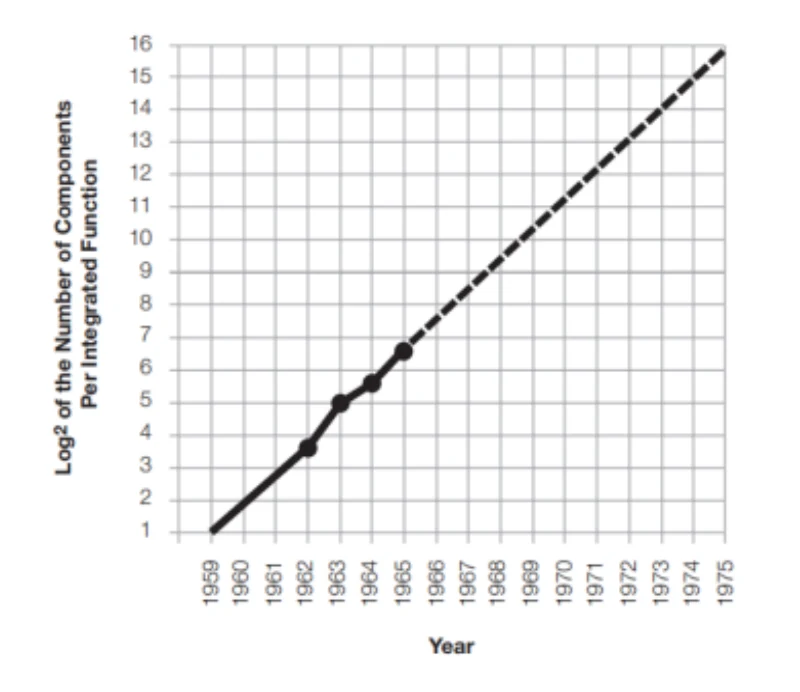
Although Moore’s Law is lauded for its predictive accuracy, Moore himself admitted that he foresaw the potential limits to the exponential growth he observed in his original article. Schaller (1997) articulated that, as a socioeconomic trend, Moore’s Law serves as an industry roadmap more so than a law of nature or a mathematical constant. Nevertheless, following Moore’s lauded publication, speculation that this trend may persist continued to mount. To this end, the futurist, Alvin Toffler (1970), conceived of a “super-industrial society” whose rate of change would appear overwhelming in his 1970 book, Future Shock. “It is clear that in super-industrial society, many such tasks will be performed by great self-regulating systems of machines, doing away with the need for bureaucratic organization. […] Far from fastening the grip of bureaucracy on civilization more tightly than before, automation leads to its overthrow” (Toffler, 1970). Computer scientist and machine learning expert Ray Solomonoff (1985) calculated what he called an “infinity point”, a mathematical point at which the rate of knowledge creation (through artificially intelligent means) would appear to reach some sort of mathematical singularity.
Hans Moravec (1988), known for his work on robotics, artificial intelligence, and writings on the impact of technology, attempted to quantify a broader interpretation of Moore’s Law in his book, Mind Children. In it, he plotted the relevant computational capacity of machines over time on a logarithmic scale.
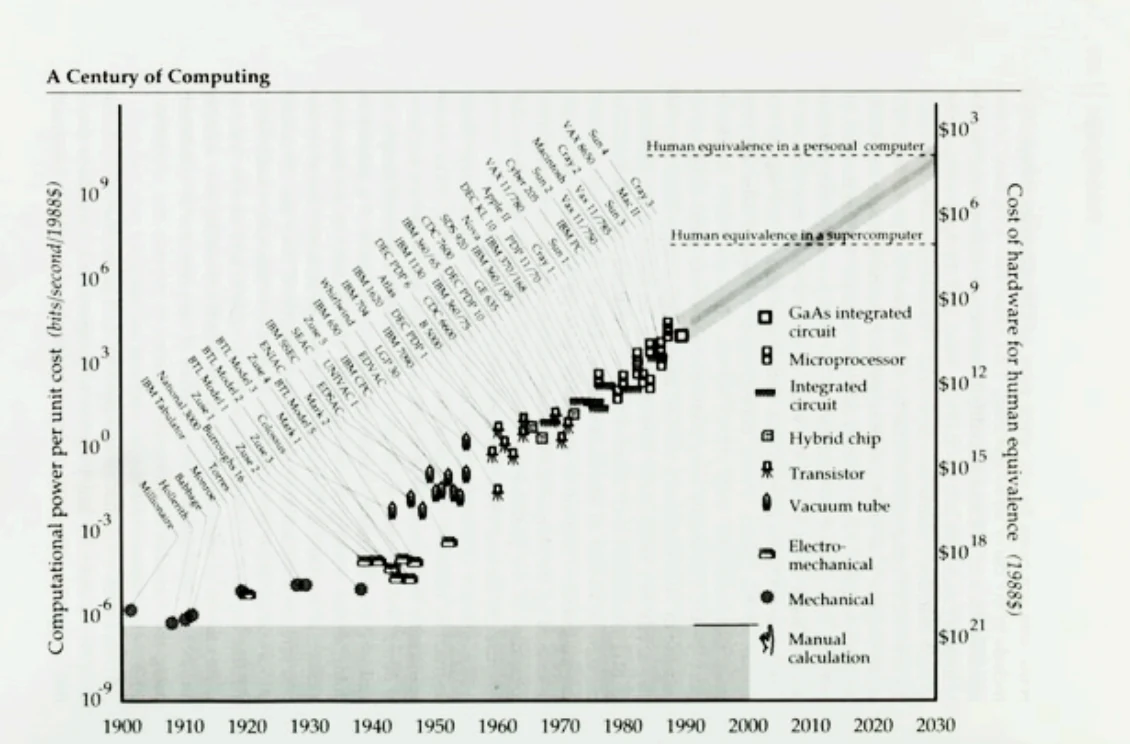
In order to do so, Moravec (1988) used a metric that allowed the comparison of cross-generational machines in bits per second per dollar.
where N is the number of possible states and pi is the probability that the i-th state will be the next one. (Moravec, 1988)
Today, floating-point operations (FLOPS) are a measure of calculations per second. Floating-point operations are needed for very large or very small real numbers or computations that require a large dynamic range. It is, therefore, a more accurate measure than ‘instructions per second’. (Roser & Ritchie, 2013)
Moravec’s results led him to conclude that superhuman machine intelligence would be possible well within the 21st century, echoing I. J. Good’s (1965) sentiment over two decades prior. Vernor Vinge (1993) later popularized the term “technological singularity” about this hypothetical historical moment, considering similar possible trajectories. He declared that the acceleration of technological progress had been the central feature of the century and saw little reason for it to abate.
Expanding upon Vinge’s notion, artificial intelligence researcher and writer best known for popularizing the idea of “friendly artificial intelligence”, Eliezer Yudkowsky (1996), in his essay, Staring at the Singularity, postulated that computing speed doubles every two subjective years of work as opposed to Moore’s claim that it occurs roughly every two calendar years. This concept is the basis of Yudkowsky’s version of the intelligence explosion. He explains that “Computing power doubles every two subjective years of work. Two years after computers reach human equivalence, their power doubles again. One year later, their speed doubles again. Six months — three months — 1.5 months … Singularity.”
The Macro-Historical Perspective
On a macro-historical time scale, Jared Diamond (1997) notes that the rate of technological development, at first, was “imperceptibly slow”, while today, modern advancements in quantum computing and virtual reality make headlines in the news on a near-daily basis. Diamond does highlight two significant jumps in humanity’s technological history that are particularly noteworthy. He notes the appearance of anatomically modern brain structure (found between 100,000 and 50,000 years ago), as well as the sedentary agrarian lifestyle adopted by much of humanity (as early as 13,000 years ago).
Harari (2014, 2017) argues that a third significant change to humanity’s physiology is underway as we rely upon machines to assume control over more physical and cognitive tasks, ranging from the storage of memories and relationships to physical prosthetics and pacemakers. Humanity is intricately entwined with its technological creations, so much so that serious thinkers about the future now take biotechnologically enhanced transhumanism rather seriously in an attempt to draw attention to poignant moral and ethical concerns. On a similarly macrohistorical basis, Harari (2014, 2017) explored post-human futures in Sapiens: A Brief History of Humankind and Homo Deus: A Brief History of Tomorrow, respectively.
While Bostrom (2014) redefined Good’s notion of the “ultraintelligent machine” in his book, Superintelligence, as “an intellect that is much smarter than the best human brains in practically every field, including scientific creativity, general wisdom, and social skills”.
In multiple works, Kurzweil (1999, 2001, and 2006) explored the law of accelerating returns and contemplated the possible futures that might result should such a trend continue.
Like Moravec (1988), Kurzweil compares machines throughout history using the metric of calculations per second per constant (inflation-adjusted) dollar.
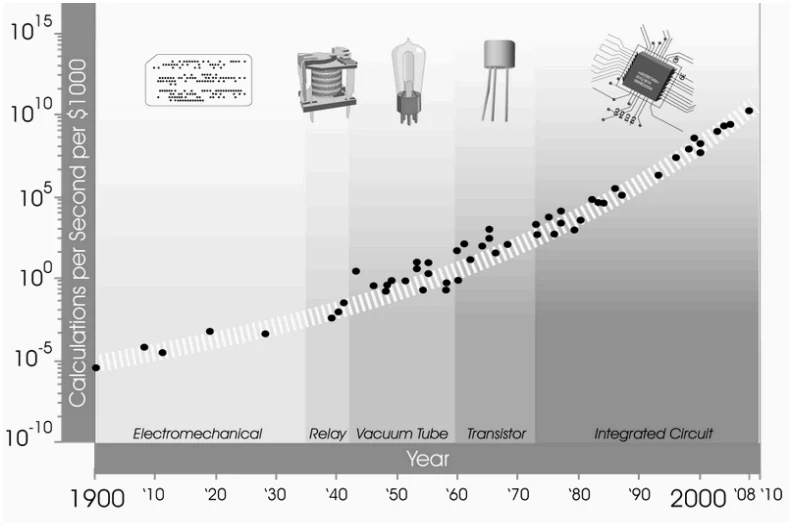
Since this report primarily investigates the central assumption underpinning much of Kurzweil’s body of work, we need not dwell on the ramifications of the law of accelerating returns. Suffice it to say that he makes a compelling argument in analysing the historical gains in efficiency of various technologies as illustrated above.
More recently, according to Bostrom & Yudkowsky (2018), there is almost universal agreement among modern AI professionals that Artificial Intelligence falls far short of human capabilities in one sense or another, thus (for the time being) mitigating Good’s intelligence explosion. This, even though AI algorithms have surpassed humans in many specific abilities, such as playing Chess and Go. General intelligence’s defining characteristic is generality, an ability to apply intelligent reasoning to novel circumstances.
Contemporary AI algorithms are still characterized by narrowly defined competencies in very restricted domains of expertise. DeepBlue may have become the world chess champion, but it could not play any other game, let alone apply its cognitive powers to a creative or complex task. (Bostrom & Yudkowsky, 2018) Such cognitive flexibility has made great strides in the preceding years, but until the point at which a generally intelligent machine can reason, there is little likelihood of any form of intelligence explosion or technological singularity.
To date, it would appear that this milestone has yet to be reached, although we cannot rule out the possibility that such a development would be a closely guarded industry secret. Tegmark (2017) describes a scenario in which the hypothetical creators of such an intelligence would successfully conceal such development while surreptitiously taking advantage of its lucrative super-human problem-solving capabilities.
Throughout history, writers of utopian science fiction have postulated a plethora of fantastical inventions that thoroughly missed the mark. Today’s critics of the posthuman “singularitarian” ideologies remind us of the folly of utopian prophecy. In 2008, Pinker (Spectrum IEEE, 2008) explained, “Look at domed cities, jet-pack commuting, underwater cities, mile-high buildings, and nuclear-powered automobiles — all staples of futuristic fantasies when I was a child that have never arrived. Sheer processing power is not a pixie dust that magically solves all your problems.”
In a hypothetical future, it can be difficult to distinguish between science fiction and science fact. Furthermore, the correlation of supporting evidence favouring Kurzweil’s thesis should not serve as a basis for its validation.
Inspired by Karl Popper’s work on inductivism, David Deutsch (1998) dedicates a chapter of The Fabric of Reality to “A Conversation About Justification”. In it, Deutsch provides some insight into how a hypothesis like Kurzweil’s can be examined. “Theories are accepted when all their rivals are refuted”, he claims. With this in mind, let us now turn to the criticisms of the theory of accelerating change.
Critiques Against Accelerating Change
The Law of Accelerating Returns (and the conjectures made thereupon) are not universally appreciated. However, by assessing the criticism against this hypothesis, we might shed light on any untenable aspects of the theory.
Moore’s Law As a Roadmap
Schaller (1997) recognized that Moore’s exponential trend could not persist indefinitely in a finite world. Today, as we reach the end of Moore’s Law, the atomic stability and reliability of nano-scale transistors have proved a genuinely insurmountable obstacle to continued miniaturization. (Schaller, 1997) The physics underlying semiconductor manufacturing suggests several possible barriers to continued technical progress and density doubling. For example, the gigabit chip generation may finally force technologists up against the limits of optical lithography. There are ways around this obstacle, but the cost may be prohibitive.
Schaller noted that economics may constrain Moore’s Law before physics does — an observation that others have called “Moore’s second law.” Far from a law of nature, Schaller (1997) provided a valuable way of conceiving Moore’s Law when he claimed that Moore’s Law is a theory about human activity. He believed that it provided a vision about what is possible rather than what is real.
“When [Moore] made this observation early on, he really gave us permission to believe that it would keep going. And so some of us went off and did some calculations about it and said, ‘Yes, it can keep going.’ And that then gave other people permission to believe it could keep going. And [after believing it] for the last two or three generations, ‘maybe I can believe it for a couple more, even though I can’t see how to get there’. […] The wonderful thing about [Moore’s Law] is that it is not a static law; it forces everyone to live in a dynamic, evolving world.” (Schaller, 1997)
Schaller’s assertion was correct, and Moore’s Law today is generally seen more as a motivational tool than a force of nature. It is crucial to consider the law of accelerating returns in such terms. Perhaps the most apparent critique against the continued trend described by the law of accelerating returns might be the direst. If all socioeconomic incentives for further improvement in computational efficiency are somehow negated or removed from the environment, we would likely see the entire trend come to a halt. Both Nick Bostrom and Max Tegmark have considered how these kinds of incentives could halt at a civilizational scale. They formed the Future of Humanity Institute and Future of Life Institute to monitor existential risks such as AI safety, biosecurity, nuclear conflict, and climate change. The Bulletin of the Atomic Scientists performs a similar role. Taleb (2007) suggests that no matter how unlikely these “Black Swans” may seem to us, they must be taken seriously. Over a long enough timeframe, even some of the unlikeliest of eventualities may transpire. In light of this, performing a scenario planning exercise that explores the ramifications of a litany of different Black Swan events may be helpful.
The Myth of Progress
Naturally, there are critiques of the law of accelerating returns that lie outside of the ambit of catastrophic surprises. Wired magazine founder, Kevin Kelly, is one of Kurzweil’s most outspoken critics. In 2007, Kelly popularized “The Maes-Garreau Point”, in which “the most favourable predictions about future technology will fall within the […] lifetime of the person making it”. Kelly explains,
In 1993 [Pattie] Maes gave a talk at Ars Electronica in Linz, Austria called “Why Immortality Is a Dead Idea.” Rodney Brooks, one of her male colleagues, summarized the talk in his book Flesh and Machines: “[Maes] took as many people as she could find who had publicly predicted downloading of consciousness into silicon, and plotted the dates of their predictions, along with when they themselves would turn seventy years old. Not too surprisingly, the years matched up for each of them. Three score and ten years from their individual births, technology would be ripe for them to download their consciousnesses into a computer. Just in the nick of time! They were each, in their own minds, going to be remarkably lucky, to be in just the right place at the right time.” Joel Garreau, a journalist who reported on the cultural and almost religious beliefs surrounding the Singularity in his book Radical Evolution, noticed the same hope that Maes did. But Garreau […] suggested that when people start to imagine technologies which seem plausibly achievable, they tend to place them in the near future — within reach of their own lifespan. (Kelly, 2007)
This argument appears to be an ad hominem one. The critique does not contend with the claims directly. More directly, Kelly’s (2012) article, The Singularity is Always Near, makes a poignant critique at one of the techniques Kurzweil uses to estimate when an intelligence explosion (or “technological singularity”) is likely to occur.
[T]he notion of a mathematical singularity is illusionary, as any chart of exponential growth will show. Like many of Kurzweil’s examples, an exponential can be plotted linearly so that the chart shows the growth taking off like a rocket. It can also be plotted, however, on a log-log graph, which has the exponential growth built into the graph’s axis. In this case, the “takeoff” is a perfectly straight line. Kurzweil’s website has scores of graphs; all showing straight-line exponential growth headed towards a singularity. However, any log-log graph of a function will show a singularity at Time 0 — now. If something is growing exponentially, the point at which it will appear to rise to infinity will always be “just about now.” […] If you define the singularity as the near-vertical asymptote you get when you plot an exponential progression on a linear chart, then you’ll get that infinite slope at any arbitrary end point along the exponential progression. […] These charts correctly demonstrate that exponential growth extends back to the beginning of the cosmos, meaning that for millions of years the singularity was just about to happen! In other words, the singularity is always “near,” has always been “near,” and will always be “near.” (Kelly, 2012)
This critique is similar to the one made by another prominent critic of the law of accelerating returns, Theodore Modis.
Exponential Curves as Logistic Curves
Theodore Modis (2012) criticises the very existence of exponential trends in nature, instead suggesting that any ostensibly “exponential” curve is, in fact, an early manifestation of the far more common logistic S-curve. Figure 4 below illustrates how an exponential and a logistic curve may follow a very similar progression until a certain diverging point.
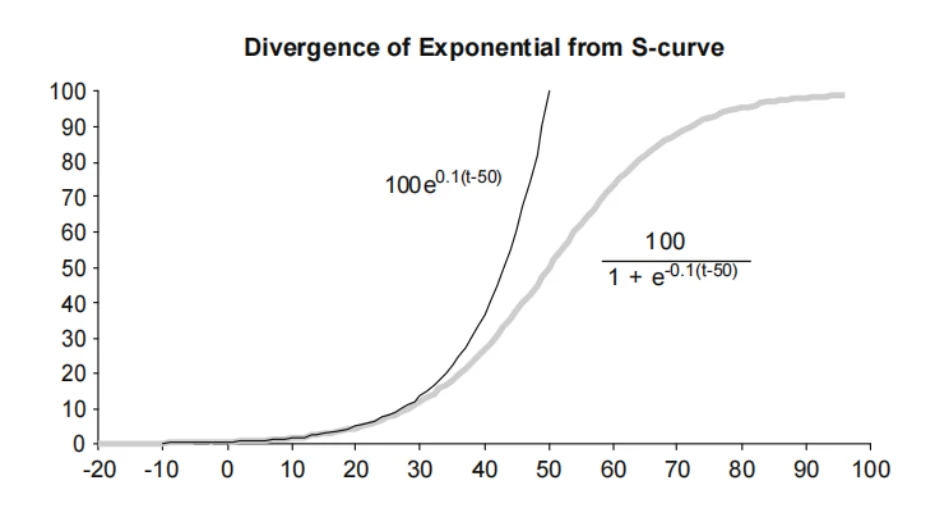
Modis (2012) argues that few (if any) exponential trends can continue indefinitely in physical reality. While much criticism against the law of accelerating returns is levelled against the fact that exponential curves do generally not occur in nature, Kurzweil agrees that a pure exponential curve is unlikely. Instead, like Kelly (2009), he notes that the aggregate returns are constituted from nested logistic curves as pictured above.
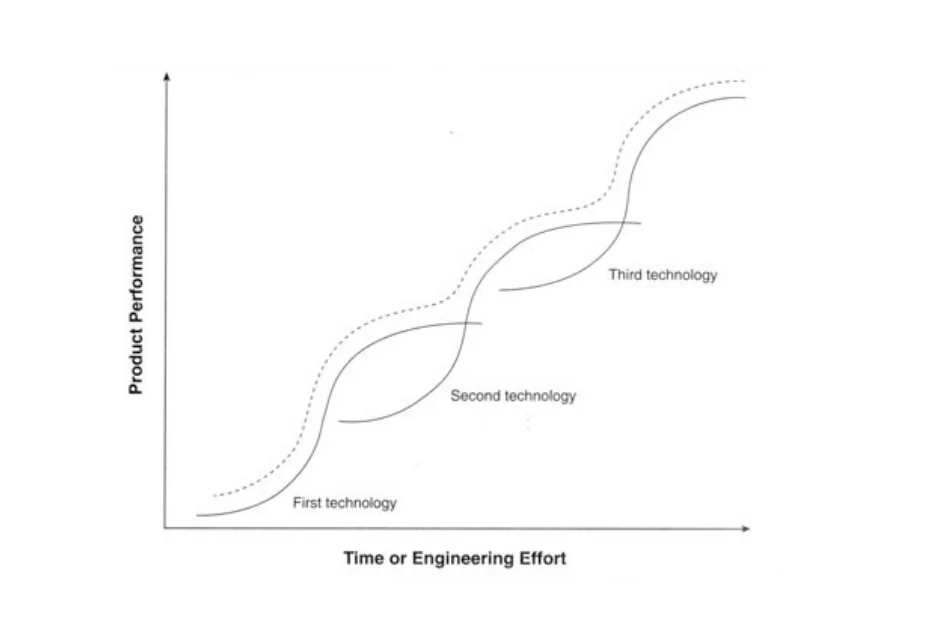
This self-similar fractal shape is indeed typical throughout nature, as Gleick (1987), Mandelbrot (2004), and Taleb (2007, 2012) have illustrated. An important question remains, however. Do these nested (fractal) curves, when combined, form an exponential curve or a logistic one on aggregate? Since mathematical exponentials continue indefinitely, this question might be answered to determine whether there is a finite “carrying capacity” regarding the environment in which the law of accelerating returns exists.
In nature, exponential growth may manifest temporarily, whilst few individuals within a population and abundant resources are available to them. However, once a population gets large enough, resource scarcity will slow a population’s growth rate. So long as there are limited resources, a growth rate will plateau, forming an S-shaped (logistic) curve.
Vandermeer (2010) mathematically models this logistic growth by modifying the exponential equation for growth as such:
Using ‘r’ (per capita growth rate) depends on population size (N) and how close it is to carrying capacity (K). (Vandermeer, 2010) However, it is clear that quantifying the carrying capacity of a driver of technological change, such as a city, can be challenging. Cities do not exist in a vacuum and are far from what we might call “closed systems”. Resources can be continually injected into a city. The Club of Rome argues that the Earth, however, certainly does have finite resources. The Club of Rome catalogued this fact in their 1972 Limits to Growth study (Meadows et al., 1972). More tangibly, we have seen the reality of logistic population growth in the declining birth rates in much of the developed world.
Nevertheless, what resources might Moore, Moravec, and Kurzweil’s trends consume?
Exponential Curves and Limited Resources
While digital information itself leaves few or no physical traces in the real world, the machines required to gather, process, and store information do. For further growth in aggregate information processing, we will likely require increasing amounts of energy. Physicists Dyson (1960) and Tegmark (2017) suggest that, in theory, there is no real reason to suspect that an inability to generate energy might hinder progress in such a manner. They surmise that it is merely a matter of making our current energy-generating and capturing technologies more efficient. In practice, however, this is not a given when we consider our Black Swan scenarios discussed in the previous section.
Other resource limitations have been chronicled in The Club of Rome’s Limits to Growth Report (Meadows et al., 1972), which examined the collapse of environments in which an ecological “carrying capacity” is reached. This report detailed how computer simulations of exponential economic and population growth might play out in a world of finite resources. Meadows et al. impress the urgency of addressing shortages in food production, arable land, clean air, clean water, and non-renewable resource consumption, among others.
Each of these variables comprises a litany of complex sub-challenges. (Meadows et al., 1972) It may sound overwhelming, but challenges like this have been overcome in the past. The overpopulation trend that was so pointed in the Limits to Growth report may not be as dire as we once believed, in part, thanks to insights made by Hans Rosling et al. “In 1948, women on average gave birth to five children each. After 1965, the number started dropping as it had never done before. Over the last 50 years, it dropped all the way to the amazingly low world average of just below 2.5.” (Hans Rosling, Anna Rosling Rönnlund, Ola Rosling, 2018)
Among such inquiries regarding the limits to growth, Geoffrey West et al. (2017) share their concerns that an accelerating rate of resource consumption accompanies growth:
[T]o sustain continued growth, major innovations or adaptations must arise at an accelerated rate. Not only does the pace of life increase with city size, but so also must the rate at which new major adaptations and innovations need to be introduced to sustain the city. These predicted successive accelerating cycles of faster than exponential growth are consistent with observations for the population of cities, waves of technological change, and the world population. (West, 2017)
Rather than a slippery slope towards an artificial superintelligence, West et al. interpret a technological singularity as a catastrophic inability to maintain growth. They surmise that if the law of accelerating returns (and by extension, technological and economic progress) is to endure globally, we will need to overcome increasingly common shortages of natural resources.
Kurzweil (2001) notes that observers are quick to criticize extrapolations of an exponential trend on the basis that it is bound to run out of “resources.” In response, Kurzweil (2001) turns to the issue we addressed in Part 1 of this report, that of the evolutionary resistance to entropy:
[T]he resources underlying the exponential growth of an evolutionary process are relatively unbounded:
(i) The (ever-growing) order of the evolutionary process itself.
Each stage of evolution provides more powerful tools for the next. In biological evolution, the advent of DNA allowed more powerful and faster evolutionary “experiments.” Later, setting the “designs” of animal body plans during the Cambrian explosion allowed rapid evolutionary development of other body organs such as the brain. Or to take a more recent example, the advent of computer-assisted design tools allows rapid development of the next generation of computers.(ii) The “chaos” of the environment in which the evolutionary process takes place and which provides the options for further diversity.
In biological evolution, diversity enters the process in the form of mutations and ever-changing environmental conditions. In technological evolution, human ingenuity combined with ever-changing market conditions keeps the process of innovation going. (Kurzweil, 2001)
To this end, Kurzweil invokes Schrödinger’s (1944) concept of “negative entropy,” in which living matter evades the decay to thermodynamic maximum entropy (see the second law of thermodynamics) by homeostatically maintaining negative entropy within an open system. Schrödinger simplified the concept by explaining that “entropy, taken with the negative sign, is itself a measure of order,” which “consists in continually sucking orderliness from its environment”. The implication, therefore, is that so long as energy and orderliness can persist within the ecology of technological innovation, there is little reason to suspect that some form of the law of accelerating returns might yet linger.
Martin Ford (2013) in The Lights in the Tunnel: Automation, Accelerating Technology and the Economy of the Future postulates a “technology paradox” in that before the singularity could occur, most routine jobs in the economy would be automated since this would require a level of technology inferior to that of the singularity. This would cause massive unemployment and plummeting consumer demand, which would destroy the incentive to invest in the technologies required to bring about the Singularity. Job displacement is increasingly no longer limited to work traditionally considered to be “routine.”
It is important to realize technology does not have to cause immediate job destruction in order to create significant future unemployment. The U.S. economy needs to generate in excess of 100,000 new jobs per month just to keep up with population growth. As a result, anything that significantly slows the rate of ongoing job creation could have a significant impact over the long term. Because workers are also consumers, entrenched technological unemployment would be very likely to depress consumer spending and confidence — thereby spawning a wave of secondary job losses that would affect even occupations not directly susceptible to automation. I suspect the impact of accelerating technology on the job market may ultimately represent a dramatic and vastly under-acknowledged challenge for both our economy and society. (Ford, 2013)
This presents a threat to the economic incentive, a crucial evolutionary driver of the law of accelerating returns.
Microsoft co-founder Paul Allen and Mark Greaves (2011) argue the existence of a “complexity brake” in which, “The more progress science makes towards understanding intelligence, the more difficult it becomes to make additional progress.”
A study of the number of patents shows that human creativity does not show accelerating returns, but, as suggested by Joseph Tainter in his book The Collapse of Complex Societies, a law of diminishing returns. The number of patents per thousand peaked from 1850 to 1900 and has been declining since. The growth of complexity eventually becomes self-limiting and leads to a widespread “general systems collapse”.
However, this is a contentious claim since the World Intellectual Property Organization (WIPO) showed an aggregate increase in recently awarded patents worldwide. (WIPO, 2019) Whether or not the complexity brake can be overcome is yet to be seen. Deutsch (1998) notes that while our specific theories are becoming more detailed and numerous, they are continually usurped by deeper, more general theories. He illustrates the point by reminding us that superior modern craftsmanship is based on a basic understanding of underlying principles rather than a complex collection of intuitions, habits, and rules of thumb. “The reason why higher-level subjects can be studied at all is that under special circumstances, the stupendously complex behaviour of vast numbers of particles resolves itself into a measure of simplicity and comprehensibility. This is called emergence.” (Deutsch, 1998)
Conceptual Diagram
In an attempt to encapsulate and illustrate the thesis of this paper, the author has created the diagram below to visually articulate a well-documented exponentially accelerating past, a pivotal juncture, and several possible futures that may come to shape the future.
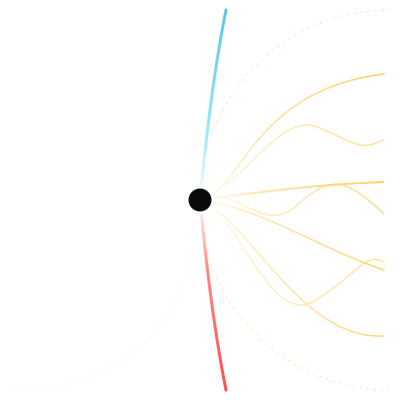
The above diagram symbolically represents the juncture at which we stand today.
On the x-axis, time flows from left to right, while the y-axis tracks humanity’s ability to process information. It is a well-documented fact that humanity has achieved seemingly exponential progress in technological advancement up to this point, exemplified by the trend known as Moore’s Law. The diagram’s centre point represents the present moment. From here, many possible futures may transpire. The optimistic vertical upward trend represents a future espoused by Kurzweil, transhumanists, and other techno-optimists. They see a future in which A new paradigm supersedes Moore’s Law, and the Law of Accelerating Returns holds. In this scenario, the Technological Singularity first commented upon by von Neumann may be a distinct possibility.
Conversely, a pessimistic vertical downward trajectory represents the existential risks that we have come to appreciate over time. The socioeconomic drivers of the Law of Accelerating Returns may have little influence in a global thermonuclear conflict or large-scale environmental collapse as envisioned by the Club of Rome. Such a decline may not be as sudden and dramatic as a sheer vertical drop. The declining curve represents this possibility. There is also a characteristic S-curve so familiar in empirical observations in natural ecological niches, favoured by Theodore Modis and others.
Part III
Evidence
According to the Law of Accelerating Returns, the rate of technological change is accelerating.
However, we are currently witnessing the long-awaited end of Moore’s Law. As West (2017) pointed out, any Pollyanna vision for the future is almost diametrically opposite to the stark predictions of neo-Malthusian environmentalists.
Is the end of Moore’s Law a leading indicator of technological stagnation, or is it, as Kurzweil would have us believe, the beginning of a new era in information processing?
Either way, one of these two camps will be left disappointed.
When unanticipated events occur, we are often left humbled by our inability to predict the future. Systems theorists point to the litany of dynamic variables at play in any given situation, many of which are unobservable. To deal with this apparent complexity, Kahneman (2011) posited that we tend to narrativise the interaction between our environment and ostensibly unpredictable actors. While such contrivances can move individuals to action, balancing ideology with a healthy measure of scepticism is necessary. A critical analysis should apply to both proponents and opponents of the Law of Accelerating Returns. The Law of Accelerating Returns is an explanatory theory that another computational paradigm will succeed Moore’s Law. This theory supposes that the memetic notion of technological innovation is subject to evolutionary pressures. As described in the literature review, this does appear to be the case, albeit under the unpredictable guise of punctuated equilibrium.
To scrutinise the end of Moore’s Law and the Law of Accelerating Returns, we need to clarify and assess the claim and its supporting data in a way that does not oversimplify the issue.
Put succinctly, Kurzweil (and others) claim that consequential evolutionary (memetic, in this case) advantages accrue over time, coalescing at an ever-increasing rate of change.
Where gradual adaptations reach their limits to growth, competitive environmental pressures culminate in regular paradigmatic shifts, prompting yet further adaptation in the future. This theory implies that Moore’s Law, while ostensibly coming to an end, is likely to be reinvented in the near-term future. It is of great significance to discern whether or not this is an appropriate form of metacognition. Whether the Law of Accelerating Returns proves true or false, the end of Moore’s Law will have deeply profound ramifications for the fields of strategic foresight and futures studies since it determines whether technology will play an increasingly central part in our socio-political and economic lives or less so. Central to this issue is an understanding of how the Law of Accelerating Returns assimilates Moore’s Law.
Clarifying Objectives
We could take the engineering approach that Gordon Moore himself took and look at how many transistors we find on microprocessors to this day, although it is clear that Moore’s Law, in its current form, is coming to an end. The economic benefits of Moore’s Law came from the shrinking of the transistor. Mack (2011) explains that this is why Moore’s Law has drifted from its historical origins as describing the number of transistors per chip to the more critical metric of minimum lithographic feature size. Whilst the popular press has failed to notice this shift in the semiconductor industry, today, there is no doubt that the historical 0.7X shrink governs the technology nodes of Moore’s Law in minimum feature size per generation.
As exhibited by IBM (2021), currently, researchers are still learning to exploit the properties of semiconductors and production processes. Inevitably, though, this technology will stop growing exponentially. Its niche will have been filled and will enter the realm of diminishing marginal returns. (Schaller, 1997) (As illustrated by Figure 8)
The cessation of Moore’s Law to another exponential trend is what Kurzweil (2001) calls a ‘paradigm shift’. “A specific paradigm (a method or approach to solving a problem, e.g., shrinking transistors on an integrated circuit as an approach to making more powerful computers) provides exponential growth until the method exhausts its potential. When this happens, a paradigm shift (i.e., a fundamental change in the approach) occurs, which enables exponential growth to continue. ” (Kurzweil, 2006)
Such breakthroughs will result from considerable research and development, and success in this regard is far from guaranteed. Innovation is inherently complex; however, according to Blackmore & Dawkins, ideas are prone to evolutionary pressures. As they have in the past, socio-economic incentives and competitive pressures might provide the necessary environment in which methodological experimentation flourishes.
Today, some technologies show great promise in disrupting and displacing more traditional forms of computation.
Below is a sampling of some of those prospective fields of study:
- **Complementary Exponential Laws: **There are many corollary exponential “laws”. Neven’s Law, named after Hartmut Neven, the director of the Quantum Artificial Intelligence Lab, describes the doubly exponential rate at which, according to Neven, quantum computational architectures are outpacing classical architectures. (Hartnett, 2019) Butters’ Law says the amount of data one can transmit using optical fibre doubles every nine months, which we can convert and say that the cost of transmission by optical fibre is halving every nine months. Rose’s Law describes the exponential growth of the number of qubits of quantum computers. (Roser, 2013)
- **Quantum Volume: **Quantum computing is inherently different from classical binary computing, and the FLOPS (floating-point operations per second) metric is decidedly unsuitable for comparing quantum computers. IBM, therefore, proposed the “quantum volume” metric to measure the rate of advancement within the field. This measure considers both error rates and qubit numbers to evaluate the quantum computational usefulness of a system. (Cross et al., 2018)
- **Parallel (Distributed) Computing: **Distributed computing uses the Internet to link personal computers to achieve greater performance levels than any of their constituent parts might on their own. (Wired, 2012)
- **Neuromorphic Circuit Architectures and 3-D Chip Stacking: **Chip architecture inspired by the plasticity of the brain’s neuronal networks, three-dimensional integration technology is intended to extend the density growth rate of Moore’s Law by stacking chips rather than simply shrinking device dimensions. ‘Wirebonded chip stacks’, ‘package on package’, and ‘package in package’ architectures currently show promise. (Sakuma et al., 2008)
Primary Research Objective
Much of the long-term strategic thinking around the future of technological advancement depends on Moore’s Law in one way or another.
For example, Ray Kurzweil’s Law of Accelerating Returns predicts that a superior computational paradigm will supersede Moore’s Law, while I. J. Good’s Ultraintelligent Machine requires a machine to possess a superhuman ability to gather, process, and disseminate information. Both presume ever-increasingly powerful computers.
With arguments for and against the longevity of Moore’s Law in the popular press, it is vital to establish whether or not Moore’s Law is valid at the present moment in an objective, empirical sense. By leveraging historical data in the public domain, we can adjudicate whether Moore’s Law has begun to peter out.
Therefore, the primary research objective of this blog series is a simple one:** To empirically assess the state of Moore’s Law in 2021.**
Secondary Objectives
Moore’s Law must end sooner or later. In Part 2 of this report, an analysis of the underlying drivers of Moore’s Law was undertaken. With this understanding, a secondary sub-objective, namely an investigation into promising technologies that aim to supersede the current manifestation of Moore’s Law, including, but not limited to:
- Energy & Materials Efficiency Improvements
(A Continuation of Moore’s Law) - Quantum Computation
- Parallel (Cloud/Edge) Computing
- Neuromorphic (3D) Circuit Architectures & Chip Density
Although outside the scope of this report, it is also essential to assess the claim that significant technological advancements accrue over time, thereby fostering an ever-increasing rate of change. As was outlined in the literature review portion of this report, Blackmore suggests that memetic adaptation is primarily the result of mimicry. Undeniably, the notion that transistor gates could be reduced was an act of mimicry. How each breakthrough occurred, however, was likely unique.
Quantitative Analysis (via Environmental Scanning)
In an attempt to synthesise empirical data from disparate industries, we will leverage aspects of environmental scanning.
Environmental Scanning Techniques
In environmental scanning, the first notable study was carried out by Francis J. Aguilar (1967). Aguilar defines environmental scanning as “scanning for information about events and relationships in a company’s outside environment, the knowledge of which would assist top management in its task of charting the company’s future course of action”. Knowledge of this “outside environment” is intended to provide an understanding of the circumstances, constraints and trends which define possible scenarios in which possible futures may transpire.
There have been many interpretations of Aguilar’s scanning techniques. Aguilar himself pioneered the PESTLE/STEEP technique in which a topic is perceived through different categorical lenses. Such a scan focuses primarily on the contextual environment, in which a systemic process of search and appraisal gives systematic attention to six environmental dimensions, viz., the economic, political, institutional, social, technological, and natural resource perspectives. Later, Slaughter (1999) deployed Ken Wilber’s Integral Theory to justify a more subjective form of environmental scanning (in stark contrast with the prevailing inclination to rely heavily upon empirical evidence). In this report, however, neither of the approaches mentioned above seems appropriate. Recall the narrowly defined problem statement of evaluating whether Moore’s Law might continue or not. By intentionally limiting the scope of this report, we are better able to thoroughly and comprehensively address the primary research objective.
The Applicability of Quantitative Analysis in the Context of Environmental Scanning
Environmental scanning involves acquiring and using information about events, trends, and relationships within a particular environment. Moore’s Law echoes such a sentiment. Moravec (1988) successfully correlated disparate information and publicised an empirical analysis of the processing capabilities of various computers throughout history. In a similar vein, this report will coalesce data from disparate sources to synthesise a coherent empirical understanding of the nature of Moore’s Law in 2021.
Primary Quantitative Data
Continually assessing Moore’s Law is an exercise conducted regularly by Gartner, Deloitte, and McKinsey; however, there are barriers to acquiring accurate and timely data on the relevant metrics therein. We could look at the rate of progress in various computing fields, though accessible data can be sparse for several reasons. The competitive nature of the semiconductor industry requires that some breakthroughs remain confidential to preserve a competitive advantage. Similarly, since such fields are nascent, narrow, and highly competitive, closely guarded trade secrets. These constraints may hamper the measurement of crucial variables, such as those used by Moore himself in 1965. Such informational asymmetry is a considerable hurdle to gathering timely and accurate data regarding this topic, but it is worth the effort to acquire first-hand data from manufacturers.
Secondary Quantitative Data
In the introduction of this report, it was noted that both Hans Moravec (1988) and Ray Kurzweil (1991) validated and expanded upon Gordon Moore’s observations with secondary data analyses. This appears to be a promising data-gathering technique. As a form of exploratory research, Kurzweil and Moravec conducted their research in an attempt to clarify and define the underlying forces that allowed Moore’s Law to persist for over half a century. Kurzweil and Moravec estimated the number of calculations (Floating point operations) that any given machine could perform per second. With such a technique, computers from different eras could be compared in their information processing capability.
A Note on Qualitative Data Collection
Also discussed in the introduction of this report, biases and heuristics were noted among most sensory appreciation of reality over time. A qualitative analysis of the supposedly increasing rate of change would be spurious. It would only gather information on the perception (micro-scale) of change over time rather than the actual (macro-scale) rate of change. Of course, such an investigation might make for an interesting psychological or sociological inquiry, but this endeavour lies outside the scope of this report’s research objectives. By focusing on quantitative data collection, we avoid administrative errors (caused by the improper administration or execution of a research task) and respondent errors and non-cooperation.
Findings
Since its inception, the semiconductor industry has used the measure of a physical dimension (the minimum gate length of a transistor) to gauge its progress. In chip design, the nanometer scale (one billionth of a meter, also expressed as 0.000000001 (10^-9) meters) refers to the length of a transistor gate. The transistor gate is a component that simply allows a current to pass through it or not. The binary symbols 1 and 0 (or on and off) represent the state of these gates. As the size of these gates decreases, more of them can be packed into a given surface area.
Gordon Moore famously observed a predictable decrease in the size of transistors over time. By making this observation, it was clear that computers would continue to get smaller and faster over time. Since many smaller transistors could be crammed onto microprocessors of a fixed size, this miniaturization process enabled an overall increase in the processing capabilities of our machines, whilst retaining (or reducing) their physical scale. However, it is essential to note that performance does not necessarily scale precisely with the transistor size. At small scales, these numbers are not precise. (Wong et al. 2020)
Is Moore’s Law Still Valid?
The primary research objective of this report is to establish if Moore’s Law is still in effect, and if so, whether it is accelerating or decelerating.
It is important to note that there are many types of microprocessors. Personal computers make use of a central processing unit (CPU), visual information is processed by a graphics processing unit (GPU), and supercomputers use novel, proprietary architectures. Despite the litany of processor architectures, they all make use of nanoscopic transistor gates.
Below (Figure 7), the plotting of MOS (Metal-Oxide-Semiconductor) transistor counts for microprocessors against their respective dates of introduction. The graph, compiled from historical and up-to-date data provided by Intel, IBM, and others, shows these counts doubling every two years, as predicted by Moore’s law.
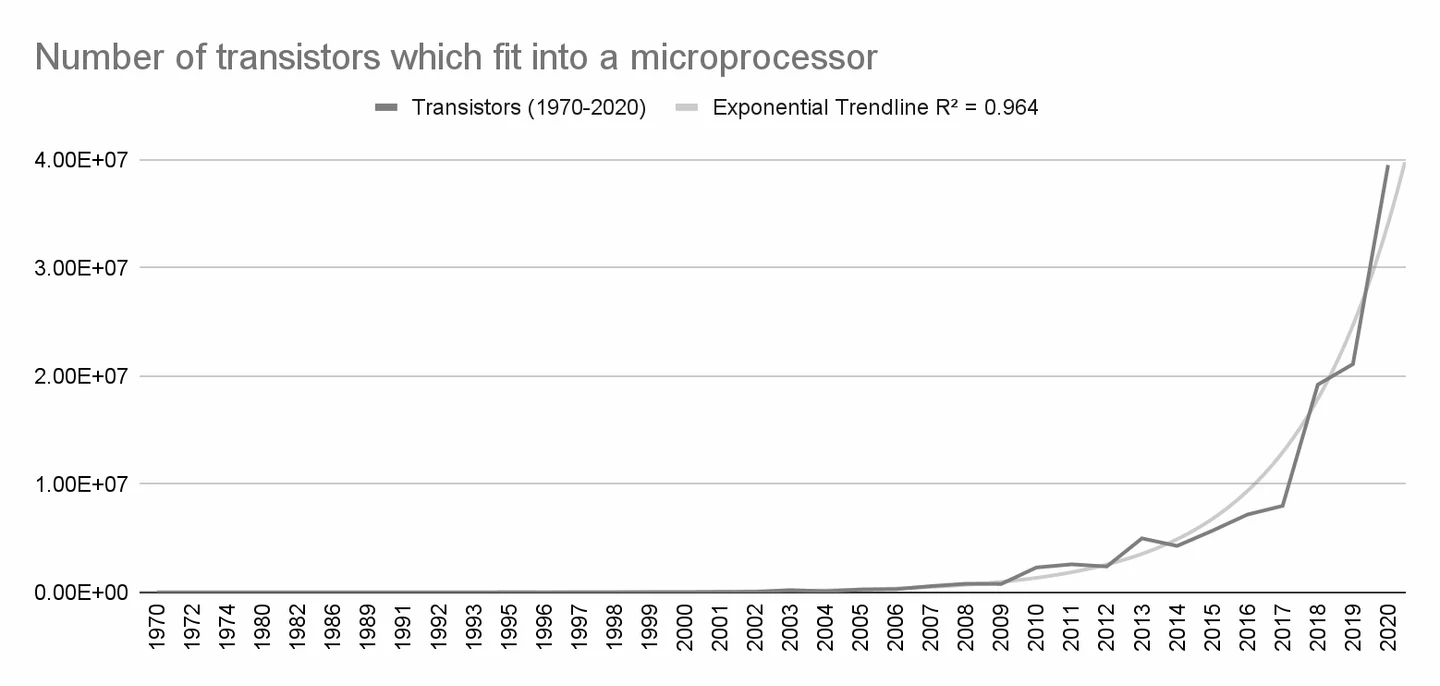
Since the trend itself is under scrutiny here, the R-squared trend for an exponential curve is significant. R-squared is the proportion of variance explained by the model, the fraction by which the variance of the errors is less than the variance of the dependent variable.
At ±99.8% confidence level, the data fit remarkably closely to a pure exponential curve. So long as the limits to growth have not yet been reached, this result should come as little surprise. Moore’s Law has been used as an industry benchmark for some time now.
In the past, Moore’s Law simultaneously accounted for and incentivised an exponential decrease in transistor size over time. These smaller components enabled a corresponding increase in transistors per microprocessor. An analysis of the (peak) transistors per microprocessor over time (Figure 7 above) illustrates how this trend persists to the current day.
While Moore’s Law ostensibly has yet to capitulate, trade secrecy around proprietary information obscures the accuracy with which we can assess this metric. There is a limit to the accuracy and currency of such an empirical analysis, yet from data in the public domain, it appears that the trend outlined by Moore’s Law persists.
When Will Moore’s Law End?
For over fifty years, Moore’s Law has continued to exhibit an ongoing trend. It is, therefore, reasonable to ask when it will come to an end. As the transistor gate size decreases over time, it approaches zero. Moore’s Law clearly cannot surpass this hard limit.
In Figure 8 below, per Gordon Moore’s initial observations, the transistor gate lithography (size in nanometers) is our primary metric. The asymptotic nature of the trendline will never truly reach zero. This might lead us to conclude that Moore’s Law will never technically end since the amount of expected change will continually decrease ad infinitum. Yet, there is a point at which it might cease to be statistically significant. Presuming that the trend continues, we can postulate that transistor sizes will reach a fraction of a nanometer sometime after 2025.
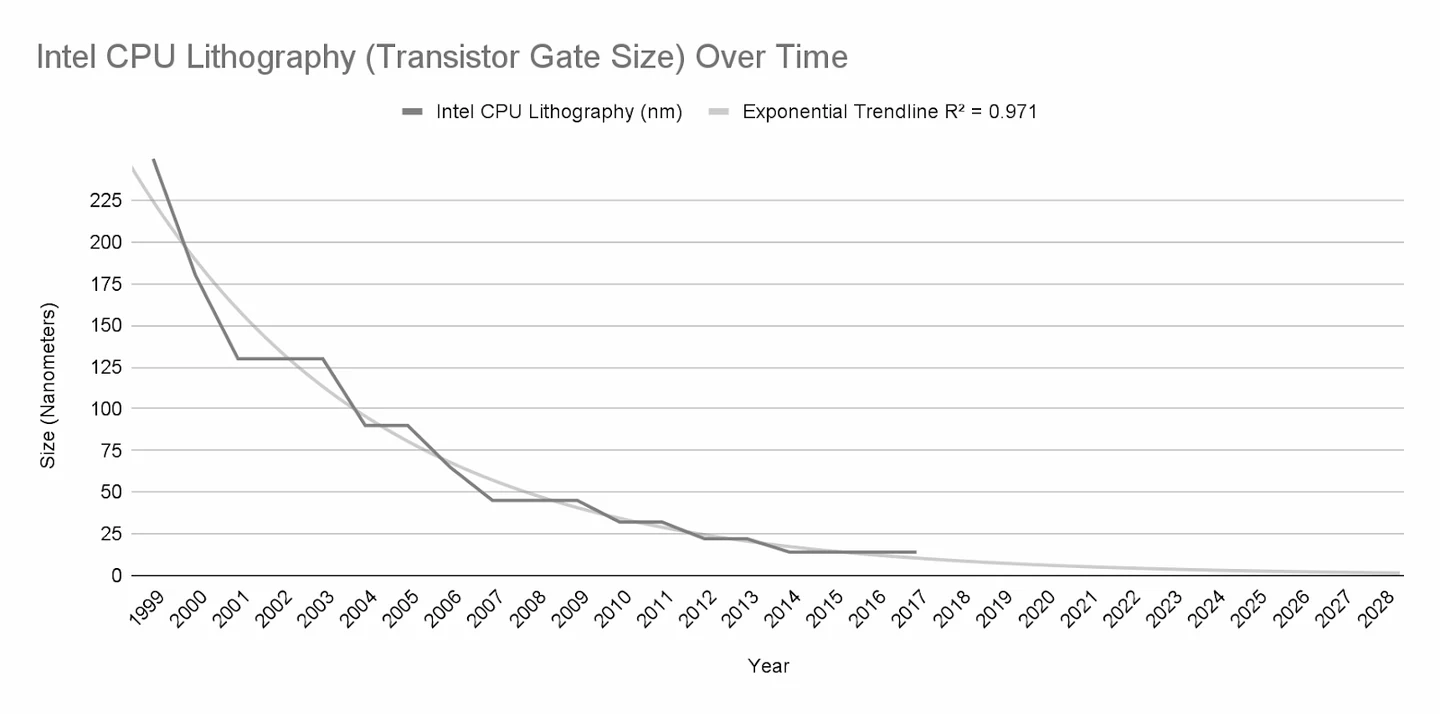
Since the trendline will never truly reach zero, and 3D chip designs appear to be a fruitful way to increase transistor density, we find that an end to Moore’s Law remains elusive. The challenge is one of semantics. Rather than witnessing the outright invalidation of Moore’s Law, new computational paradigms have instead made Moore’s Law redundant. It describes an antiquated mode in which breakthroughs were previously made. Today, this is no longer the case.
While computational efficiency continues to break new ground, we should expect to find continuing improvements in the areas that Moore’s Law has enabled thus far:
- Increased computational density (more computation per volumetric space)
- The affordability of increasingly efficient computational tools
- Ubiquitous information gathering on a granular level (remote real-time data collection)
- More complex simulations (detailed modelling of real and hypothetical environments)
The Current State of The Art
As illustrated in Figure 7, an analysis of the sheer number of transistors on a microprocessor (Moore’s Law in the strict sense) confirms that, since 2019, the semiconductor industry has not only met the expectations set by Moore’s Law, but exceeded them. From this, it would appear that Kurzweil’s (2006) claim that transistor density accelerates at a super-exponential (greater than exponential) rate may be correct. As has been pointed out earlier in this report, this should come as little surprise to us. Despite Moore himself noting that ,in its strictest form, Moore’s Law must come to an end eventually, as a motivational tool, Moore’s Law has been used as a benchmark, incentivising teams of engineers to continually develop hardware that meets or exceeds the expectations set by Moore’s Law.
The End of Moore’s Law in the 21st Century
The next node in development is the size of only about a dozen atoms, and Figure 8 gives the impression that semiconductor fabrication may soon reach a physical barrier that it cannot surmount. That said, the asymptotic nature of the exponential curve will never actually reach zero no matter how much time is allowed for on the x-axis. The closest it can get to true zero might be a negligible fraction of a nanometer.
However, Wong, et al. (2020) assert that it is a foregone conclusion that the semiconductor industry will continue to make progress since there are still many ways to advance semiconductor technology beyond 2D miniaturization.
The Importance of Density
The overall impression we might take away from these empirical analyses is that while the decrease in size continues at a slower rate (Figure 8), the density of transistors per microprocessor accelerates (Figure 7). For each miniaturization step, there is a corresponding increase in density. As such, Wong et al. (2020) propose that the nanometer metric “is all but obsolete today” for not simultaneously accounting for logic, memory, and packaging/integration technologies. They propose that lithography (size) is not the definitive factor determining processor speeds. They note the following historical density trends, all of which show strong support for nonlinear, geometric progression, including:
- Transistor density (the number of transistors divided by chip area and SRAM bit density)
- DRAM (Dynamic Random-Access Memory) bit density
- Interconnect density between memory and logic (A and B above)
The findings of Figure 7 and Figure 8 highlight the pivotal nature of computational density (and therefore efficiency) over that of sheer scale.
A Broader Definition
The deterministic lithography-centric model that is Moore’s Law omits the vast majority of progress being made in adjacent fields that have a comparable influence on computational efficiency, including memory. While an end to Moore’s Law has yet to manifest, a rapid, nonlinear rate of change has been observed in the following fields:
- Fibre-optic capacity — Keck’s law predicts that the number of bits per second that can be sent down an optical fibre increases exponentially, faster than Moore’s law.
- Network capacity — Butters’ Law of Photonics says that the amount of data coming out of an optical fibre doubles every nine months.
- Edholm’s law — Phil Edholm observed that the bandwidth of telecommunication networks (including the Internet) is doubling every 18 months.
Among these areas of research and development, there are presumably other additional fields taking similar strides forward, spurred on by similar economic incentives to those of the semiconductor industry. Rather than focusing solely on the single, somewhat outdated metric of lithography, we might do well to consider a broader array of possible futures going forward.
Recommendations
Suppose a similarly energizing socioeconomic force succeeds Moore’s Law.
In that case, it is of the utmost importance that we take Kurzweil’s interpretation of Moore’s Law (the law of accelerating returns) seriously. In short, the rate of technological change is not dependent upon a strict definition of Moore’s Law. Such a notion will alter strategic thinking about the near, medium, and long-term future.
A mature strategic outlook, open to the possibilities of a more data-centric future, should be able to see past the politically charged us-vs-them rhetoric and deeply consider the reality of a post-Mooreian world.
Continued in Part 4.
Part IV
Conjecture
Any entity with a stake in the field of information technology (or its adjacent fields) needs to seriously consider the possible consequences inherent in a post-Moore’s Law macro-environment. Rigorous scenario planning procedures might inform commensurate adjustments to business processes and protocols.
When I wrote these words back in 2021, I believed we sat at a precipice, one at which Moore’s Law had all but come to an end. In 2025, I think we’re still there.
The odds of each consequential scenario coming to bear are not evenly distributed, but should technological progress continue to advance at an ever-increasing rate, the world will continue to look progressively different as time goes by. In Taleb’s (2007) terms, this might likely manifest in an increasing number of “Black Swan” (unpredictable) events. There is a significant risk in omitting such a possibility from long-term planning sessions.
Few deterministic cause-and-effect relationships are found in a complex environment in which the primary actors are people, businesses, and industries. By adopting the “Precipicism” model in scenario planning sessions, we admit that we are open to multiple possible outcomes regarding the end of Moore’s Law. We can prepare businesses and governments for the three possible futures detailed herein by taking such a stance. Doing so clearly mitigates risk whilst remaining open to new opportunities.
A Caveat: The “Brick Wall” Scenario
Much of this series has focused on the possibility of Moore’s Law being succeeded by another computational paradigm.
That said, as many have pointed out (see Part 2), there is the possibility that Moore’s Law will not be superseded if Moore’s Law should run into a metaphorical brick wall. Despite organizations such as the Future of Life Institute and the Bulletin of the Atomic Scientists’ attempt at monitoring existential risks, such possibilities warrant their thorough independent investigation and serve as a possible catastrophic end to Moore’s Law.
Computational Paradigms
At this point, I realised that there is much work yet to be done. Below, a history of the Law of Accelerating Returns, and a brief overview of promising technologies that aim to expand upon it.
| Year | Architecture | Est. MIPS* | Est. FLOPS** | Source |
|---|---|---|---|---|
| n/a | Human brain (est.) | 2×10⁻¹ | Moravec (1988) | |
| ±1890 onwards | Mechanical calculating devices | 7×10⁻² (1891) | n/a | Moravec (1988) |
| ±1939 onwards | Relay-based “Robinson” machine | 4×101 (1939) | n/a | Moravec (1988) |
| ±1943 onwards | CBS vacuum tube | 4×10³ (1943) | n/a | Moravec (1988) |
| ±1960 onwards | Transistor-based machines | 2×10⁶ (1960) | 670,000 FLOPS (1960) | Smith (2009) |
| ±1968 onwards | Integrated-circuit-based personal computer | 1×10⁷ (1968) | 307 GFLOPS (2019) | Wong (2021) |
| ±1979 onwards | Microprocessor | 2×10⁷ (1979) | n/a | Moravec (1988) |
| ±1970 onwards | Energy & materials efficiency improvements | n/a | 1,209 GFLOPS (2019) | Intel (2021) |
| ±1997 onwards | GPU | n/a | 13,440 GFLOPS (2019) | Wong (2021) |
| ±1990 onwards | Parallel (distributed) computing | n/a | 2.3 exaFLOPS (2020) | Folding@Home (2021) |
| TBD | Neuromorphic / 3D chip architecture | n/a | TBD | TBD |
| TBD | Quantum computing | n/a | TBD | TBD |
* Million instructions per second. ** Floating-point operations per second.
Each year, there is an opportunity to reassess the validity and applicability of Moore’s Law.
We should expect two things when doing so:
- The limits to growth in the 2D miniaturization mode will be reached, given enough time
- Markets will explore more and more novel architectures in response to market pressures
With this in mind, the end of Moore’s Law does not necessarily need to be considered a simple “yes-or-no” question. In the strict sense that transistor sizes will decrease exponentially, Moore noted that a limit would eventually be reached. It should therefore come as no surprise when such a day arrives. In 2021, however, it would appear that Moore’s Law shows few signs of slowing down. Perhaps more importantly, however, the analysis of the underlying forces at work that underpins Moore’s Law must be continually examined. The result of such an examination suggests a deeper, broader, and richer theory of technological change.
If we refer to the biological analogy made in part 2 of this report, we might be tempted to compare the end of Moore’s Law to a Cambrian Explosion of evolutionary offshoots. An environmental niche is in the process of being filled. To conjecture on the possible futures that may result from such a metaphorical “explosion” lends itself to the realm of speculative fiction.
In this report, however, the possibility of a continued accelerating rate of change is taken seriously. Moore’s Law demonstrated that surprisingly rapid change is possible, and the “Precipicism” model prompts us to consider how such a trend might continue (provided a new computational paradigm successfully emerges from the competitive milieu of the free market).
Policy Recommendations
With regards to strategic foresight and policy formation, this analysis has relevance in several contexts. While the term “exponential” can sometimes be erroneously misconstrued as a repeated doubling, the mathematical formulation of exponential growth does not require such rapid acceleration. An exponential curve can describe any increase (x) wherein the base (b) is positive and real (greater than 1).
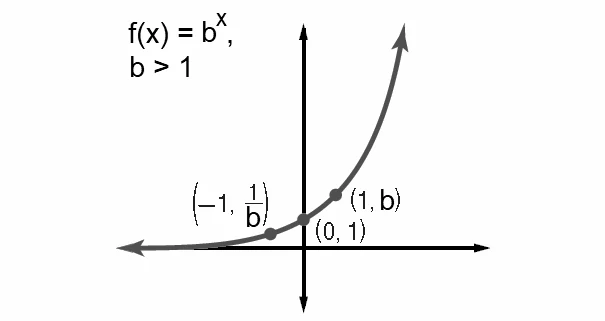
The rate of change inherent in a non-linear process may appear indistinguishable to the casual observer. Nonlinear growth, however, is a standard feature found in many empirical studies of human activity. Such examples include world population growth, global industrial production, and economic growth rates. (Meadows et al. 1972) Intuitively, this makes sense since (other than anecdotally) none of us have witnessed population, industrial and economic growth, and yet we know they exist. As a complex phenomenon, though, we should not expect our empirical measurements to precisely cohere with the predictions made by simple (non-complex) mathematical models. There are limits to our ability to measure and predict such phenomena, which represents an epistemological dichotomy. We know a phenomenon is at work, but our ability to empirically measure and predict it is limited.
According to Meadows et al. (1972), dynamic modelling theory indicates that any exponentially growing quantity is somehow involved with a positive feedback loop. In such an event, a chain of cause-and-effect relationships closes on itself, so that increasing any one variable within the loop will start a sequence of changes that will result in the variable increasing even more. This process is sometimes known as a “vicious cycle”.
“Wright’s law” (The acknowledged first documented qualitative description of this dates from 1885. A power curve was used to describe this phenomenon in a 1936 discussion of the cost of aeroplanes.) and the “Experience Curve Effect,” says that each doubling of the cumulative production of virtually any product or service is accompanied by an approximate constant percentage reduction in the unit cost. (Wright, 1936)
Regarding Moore’s Law, the development of faster and more affordable transistors has resulted in profits for the companies that make such breakthroughs, thus incentivising further investment into research and development.
The exponential growth of a population occurs when a population has a continuous birth rate throughout time and is never hindered by the absence of food or the abundance of disease. To illustrate, imagine a bacterium divides in two, resulting in two bacteria. If these divide, the result is four bacteria. If these divide, the result is eight, then 16 and then 32. Notably, this process will continue until resources become scarce or run out.
In real-world situations, it is common for populations to be restricted by a lack of food and the presence of predators and diseases. As conditions become crowded, the population approaches the upper limit of the number of individuals the environment can support. This upper limit is referred to as its “carrying capacity.” Thus, in logistic growth patterns, we can expect the population to increase exponentially up to a point and then suddenly level off as resources become scarce.
Mathematically, Wright’s law takes the form of a power function. Empirical research has validated the following mathematical form for the unit cost Cx of producing the xth unit, starting with unit C1, for a wide variety of products and services:
Where b is the progress ratio and 1-b = l is the proportional reduction in unit cost, doubling the cumulative production (learning rate).
Limitations of This Analysis
Black Swans
Moore’s Law has proven remarkably “reliable” for over half a century. That is to say, relatively speaking, it appears to hold surprisingly true despite many subtle deviations from the mathematical basis underlying the trend. That said, it is extremely important to remember that “Black Swan” events (unpredictable shifts away from a status quo) do happen. Trends such as Moore’s Law can appear to hold true, until the moment they don’t.
Moore’s Law is a socioeconomic incentive structure that is beholden to the same environmental risks that have taken us by surprise in the past. The semiconductor industry relies upon a relatively small number of large organizations based in the USA, Korea, and China, and a disruption to those businesses or the industry may adversely affect the ostensibly stable trend we’ve observed thus far. Partly spurred by the COVID-19 pandemic, the recent “chip shortage”, a disruption in the global supply of microprocessors (despite growing demand), is an example of a change in the socioeconomic environment which had an impact on many trends that (by definition) omit such possibilities. This again speaks to the systemic nature of a world outside of the strict reductionism of a trend as such.
Should Moore’s Law continue or not, is an interesting question. Equally so, we should consider if and how this microprocessor-based paradigm might be superseded by a novel breakthrough technology. If so, it would be equally important to consider if we should expect technological progress (and our ability to process larger amounts of information more quickly) to continue, or in fact accelerate, unabated.
Whilst the very mode of computation represented by Moore’s Law may be coming to an end, it is uncertain whether a subsequent correlate of Moore’s Law will result in a similar mode of information processing. This is exemplified in the fact that the algorithms processed by quantum machines are of a different kind from those of microprocessors. Although the number of calculations made per second may differ greatly between the two architectures, the purpose for which each calculation is made is markedly different. This is just one example of many, since there are a litany of new architectures emerging (as described in Table 3 above).
Trade Secrecy
We face a level of informational asymmetry concerning gathering information on the state of the art in semiconductor research and development. There are a host of unknown unknowns that are represented by trade secrecy. Despite our best efforts, the competitive nature of the open market poses a challenge to researchers performing a meta-analysis of the state of the art. By primarily utilizing data in the public domain, we cannot identify the actual state of Moore’s Law at present.
Rhetoric and Misinformation
As Moore himself has repeatedly pointed out, Moore’s Law was always destined to come to an end. An important question now, then, is what form will it take in the future?
This question is frequently taken up by laypeople and commentators that might veer the debate away from empirical evidence and towards an economic, political or cultural agenda. While there certainly are political and societal ramifications to the end of Moore’s Law, the hype, rhetoric, cynicism and spin can misinform and detract from the empirical investigation and evidence-based analysis of the matter.
With this in mind, data in the public domain may be the result of such efforts. To mitigate such risks, researchers must utilize diverse data sources and treat each source with some measure of healthy scepticism.
Future Iterations of Moore’s Law
The evolution of computing did not start with integrated circuits (±1958) or transistors (±1947) but goes back to electromechanical calculators (±1890). More recently, the ‘von Neumann’ architecture has been widely deployed since 1945, which has stewarded Moore’s Law throughout its history. Today, it still serves as the backbone of the majority of our processing capabilities. However, energy & materials efficiency improvements and novel forms of computation such as 3D-chip architectures, GPU processing, and quantum computing pose possible routes forward (towards an ever-higher MIPS/FLOPS rate).
Since the medium through which our processing capabilities are made have undergone several fundamental changes throughout the 20th century, we must look ahead towards possible similar shifts.
As illustrated in Table 3, the combined capabilities of Parallel (Distributed) Computing overshadows its constituent machines. However, it is an inherently different architecture (and way of thinking about computation) from its predecessors. Similar principles such as Ethereum’s “world computer” concept lean heavily on this architectural decision to distribute the processing load among a litany of “node” computers. Such configurations challenge the very notion of what a computer can be. Since these constituent machines wholly rely upon the miniaturization process described by Moore, they blur the lines between component, machine and network.
As far as data processing is concerned, such networks have shown that they are more than capable of outperforming some of the world’s fastest stand-alone computers. In sheer terms, the computational resources at hand (processors, memory and energy) in such an arrangement are significantly greater.
While quantum computers are still in their infancy, it is apparent that they will not be used for the same purposes as traditional microcomputers. As such, quantum computers, much like supercomputers, are of a category unto themselves. The differences are a matter of kind rather than degree, and the applications of quantum bits (qubits) are far less diverse than the binary digit (bit).
While quantum computers and supercomputers are efficient data-processing machines, the class of logical functions are vastly different from those of classical computers. Such a discrepancy suggests that not all data processing is equal.
These and other possible successors to Moore’s Law are interesting in their own right, but a fundamental barrier arises when comparing them. Since they are of entirely different architectures, the class of logical functions performed by each is inherently different. It is, therefore, an open question whether comparing different architectures using the FLOPS (or previously MIPS) metric is advisable. The Church-Turing thesis favours such metrics, which argues that phenomena could theoretically be reduced to mathematical operations, albeit only the computable phenomena. (Deutsch, 1998 & Kurzweil, 1999) This branch of philosophical inquiry is in its infancy and may prove fruitful as our ability to simulate more and more complex systems matures over time.
Conclusion
The breadth and depth of humanity’s computational capacity has significantly expanded in recent history. Moore’s Law, in one simple graph, encapsulates this profoundly influential trend. A predictable rate of the miniaturization of transistors fostered an environment wherein the internet, increasingly efficient smartphones, and social media could emerge. Today, these tools are ubiquitous in the developed world.
These are not superfluous inventions by any means and have facilitated a change in the nature of communication. So much so that Harari (2014) went as far as to compare the significance of this technological leap to the development of written and spoken languages. Through these means, information can be gathered, processed and disseminated quickly and at scale. By gathering information and simulating hypothetical environments and events, we are better able to plan for the future. This abstract reasoning faculty has been augmented through increasingly influential means of computation.
As a category of tools and artefacts, increasingly capable computers empower individuals, states and businesses with an increased capacity to recall stored information and quickly process logical processes and mathematical functions. With such strides being made, we have seen growing demand for increasingly efficient information technologies.
With this in mind, I. J. Good postulated the “ultraintelligent machine”; a tool that would one day “far surpass all the intellectual activities of any man, however clever”. Recently, we’ve seen such milestones passed. Artificially intelligent algorithms have surpassed the intellectual efforts of clever chess players in 1997 and clever go players in 2016. In part, thanks to decades of breakthrough advancements in the semiconductor industry. Machine intelligence can now compute logical and mathematical functions at an increasing rate and an increasingly large scale.
Good surmised that an ultraintelligent machine might design further machines resulting in an “intelligence explosion”. This notion, a predecessor to Vernor Vinge’s “Technological Singularity” and Kurzweil’s Law of Accelerating Returns. Today, researchers take these issues seriously and aim to inform policymakers of the potential risks that might materialize should Good’s conjecture prove prophetic.
Humanity has exploited its ecological niche through intelligence, the practical application of abstract logical problem-solving capabilities. By gathering information, integrating it into our worldviews, and simulating hypothetical outcomes, we can take action and observe the consequences thereof. By learning about and interacting with the world, we iteratively improve our collective understanding of it. When we put machines to the task of automating these activities, the advantages of inorganic memory and processing increase the aggregate sensemaking capability of our species.
However, an immutable trend of digitization, prosperity, and progress is a Utopian fantasy. In reality, we bake our own biases and heuristics into our tools, and we regularly encounter surprises that reverse ostensibly reliable trends altogether. Economic bubbles burst, wars are declared, and pandemics derail previously predictable empirical patterns. The culmination of a billion tiny perturbations swirling within a complex system on the micro-level can coalesce into an abrupt emergent cataclysm on the macro-level. Similarly, in the biological realm, the exploitation of a niche can end when organisms reach their limits to growth. The manifestation of these trend-reversing effects can be rapid, or they can be gradual.
The end of Moore’s Law is the intersection between these possible futures and, we must examine them closely and determine the likelihood of each possible future to better influence the course of history in the direction of our choosing.
Sources
References
- Aguilar, F. J. (1967). Scanning the Business Environment. New York: Macmillan.
- Allen, P. G. & Greaves, M. (2011, October 12). The Singularity Isn’t Near. MIT Technology Review.
- Bejan, A. (2019). Why the Days Seem Shorter as We Get Older. European Review, 27(2), 187–194. https://doi.org/10.1017/S1062798718000741
- Blackmore, S. (1999). The Meme Machine. Oxford University Press.
- Bostrom, N. (2014). Superintelligence: Paths, Dangers, Strategies. Oxford University Press.
- Bostrom, N. & Yudkowsky, E. (2018). The Ethics of Artificial Intelligence. In Artificial Intelligence Safety and Security. Chapman and Hall. Previously published in The Cambridge Handbook of Artificial Intelligence (2014).
- ComplexityExplorer.org (2020). Complex system. https://www.complexityexplorer.org/explore/glossary/391-complex-system
- Cross, A. W. et al. (2018). Validating quantum computers using randomized model circuits. IBM T. J. Watson Research Center. https://arxiv.org/pdf/1811.12926.pdf
- Darwin, C. (1859). On the Origin of Species. Digital edition, A. M. Goldstein (ed.). https://darwin.amnh.org/files/images/pdfs/e83461.pdf
- Dawkins, R. (1976). The Selfish Gene. Oxford University Press.
- Deutsch, D. (1998). The Fabric of Reality: The Science of Parallel Universes — and Its Implications. New York: Penguin.
- Diamond, J. (1997). Guns, Germs, and Steel. New York: W. W. Norton.
- Dyson, F. J. (1960). Search for Artificial Stellar Sources of Infra-Red Radiation. Science, 131(3414), 1667–1668.
- Folding@Home (2021). OS statistics. https://stats.foldingathome.org/os
- Ford, M. (2013). Could Artificial Intelligence Create an Unemployment Crisis? Communications of the ACM, 56(7). http://www.thelightsinthetunnel.com/Comm_ACM_Martin_Ford.pdf
- Gleick, J. (1987). Chaos: Making a New Science. London: Cardinal.
- Good, I. J. (1965). Speculations Concerning the First Ultraintelligent Machine. Advances in Computers, 6.
- Gould, S. J. & Eldredge, N. (1993). Punctuated equilibrium comes of age. Nature, 366(6452), 223–227.
- Gould, S. J. (2009). Punctuated Equilibrium. Harvard University Press.
- Harari, Y. N. (2014). Sapiens: A Brief History of Humankind. London: Vintage.
- Harari, Y. N. (2017). Homo Deus: A Brief History of Tomorrow. London: Vintage.
- Hartnett, K. (2019, June 18). A New Law to Describe Quantum Computing’s Rise? Quanta Magazine. https://www.quantamagazine.org/does-nevens-law-describe-quantum-computings-rise-20190618/
- Hiltunen, E. (2020). Wild Cards and Weak Signals. In R. Slaughter & A. Hines (eds.), The Knowledge Base of Futures Studies 2020.
- IBM (2021, May 6). IBM Unveils World’s First 2 Nanometer Chip Technology, Opening a New Frontier for Semiconductors. https://newsroom.ibm.com/2021-05-06-IBM-Unveils-Worlds-First-2-Nanometer-Chip-Technology,-Opening-a-New-Frontier-for-Semiconductors
- IEEE (2017). International Roadmap for Devices and Systems. https://web.archive.org/web/20181025031319/https://irds.ieee.org/images/files/pdf/2017/2017IRDS_MM.pdf
- Intel (2021). Intel Core i9-10980XE Extreme Edition processor specifications. https://ark.intel.com/content/www/us/en/ark/products/198017/
- Kahneman, D. (2011). Thinking, Fast and Slow. New York: Farrar, Straus and Giroux.
- Kelly, K. (2007, March 14). The Maes-Garreau Point. The Technium. https://kk.org/thetechnium/the-maesgarreau/
- Kelly, K. (2012). The Singularity Is Always Near. The Technium. https://kk.org/thetechnium/the-singularity/
- Kondepudi, D., Petrosky, T. & Pojman, J. A. (2017). Dissipative structures and irreversibility in nature. Chaos, 27, 104501. https://doi.org/10.1063/1.5008858
- Kurzweil, R. (1999). The Age of Spiritual Machines. London: Phoenix.
- Kurzweil, R. (2001). The Law of Accelerating Returns. https://www.kurzweilai.net/the-law-of-accelerating-returns
- Kurzweil, R. (2006). The Singularity Is Near: When Humans Transcend Biology. New York: Viking.
- Mack, C. A. (2011). Fifty Years of Moore’s Law. IEEE Transactions on Semiconductor Manufacturing, 24(2). https://ieeexplore.ieee.org/document/5696765
- Malthus, T. R. (1798). An Essay on the Principle of Population, as it Affects the Future Improvement of Society. London: J. Johnson. http://www.esp.org/books/malthus/population/malthus.pdf
- Mandelbrot, B. B. & Novak, M. M. (2004). Thinking in Patterns: Fractals and Related Phenomena in Nature. World Scientific.
- McLuhan, M. (1964). Understanding Media: The Extensions of Man.
- Meadows, D. H. et al. (1972). The Limits to Growth: A Report for the Club of Rome’s Project on the Predicament of Mankind. New York: Universe Books.
- Modis, T. (2012). Why the Singularity Cannot Happen. In Singularity Hypotheses (pp. 311–346). Springer.
- Moore, G. E. (1965, April 19). Cramming more components onto integrated circuits. Electronics, 38(8).
- Moravec, H. P. (1988). Mind Children: The Future of Robot and Human Intelligence. Harvard University Press.
- Pinker, S. (2018). Enlightenment Now: The Case for Reason, Science, Humanism, and Progress.
- Popper, K. (1963). Conjectures and Refutations: The Growth of Scientific Knowledge. London: Routledge.
- Pudding.cool (2018). Human Terrain. https://pudding.cool/2018/10/city_3d/
- Robison, E. (2016). Why does time seem to speed up with age? Scientific American Mind, 27(4), 73. https://doi.org/10.1038/scientificamericanmind0716-73
- Roser, M. & Ritchie, H. (2013). Technological Progress. Our World in Data. https://ourworldindata.org/technological-progress
- Rosling, H., Rosling Rönnlund, A. & Rosling, O. (2018). Factfulness: Ten Reasons We’re Wrong About the World — and Why Things Are Better Than You Think.
- Russell, B. (1990). The Problems of Philosophy. Indianapolis: Hackett.
- Sakuma, K. et al. (2008). 3D chip-stacking technology with through-silicon vias and low-volume lead-free interconnections. IBM Journal of Research and Development, 52(6).
- Schaller, R. R. (1997). Moore’s Law: Past, Present, and Future. IEEE Spectrum.
- Schrödinger, E. (1944). What Is Life? The Physical Aspect of the Living Cell. Cambridge University Press.
- Simonite, T. (2016, May 13). Moore’s Law Is Dead. Now What? MIT Technology Review.
- Slaughter, R. A. (1999). A new framework for environmental scanning. Foresight, 1(5), 441–451. https://doi.org/10.1108/14636689910802331
- Smith, E. (2009). IBM Stretch. http://www.brouhaha.com/~eric/retrocomputing/ibm/stretch/
- Solomonoff, R. (1985). The Time Scale of Artificial Intelligence: Reflections on Social Effects. Human Systems Management, 5. https://doi.org/10.3233/HSM-1985-5207
- Spectrum IEEE (2008). Tech Luminaries Address Singularity. https://spectrum.ieee.org/computing/hardware/tech-luminaries-address-singularity
- Taleb, N. N. (2007). The Black Swan: The Impact of the Highly Improbable.
- Taleb, N. N. (2012). Antifragile: Things That Gain from Disorder. New York: Random House.
- Tegmark, M. (2017). Life 3.0: Being Human in the Age of Artificial Intelligence.
- Toffler, A. (1970). Future Shock. New York: Random House.
- Ulam, S. (1958). Tribute to John von Neumann. Bulletin of the American Mathematical Society, 64(3, part 2).