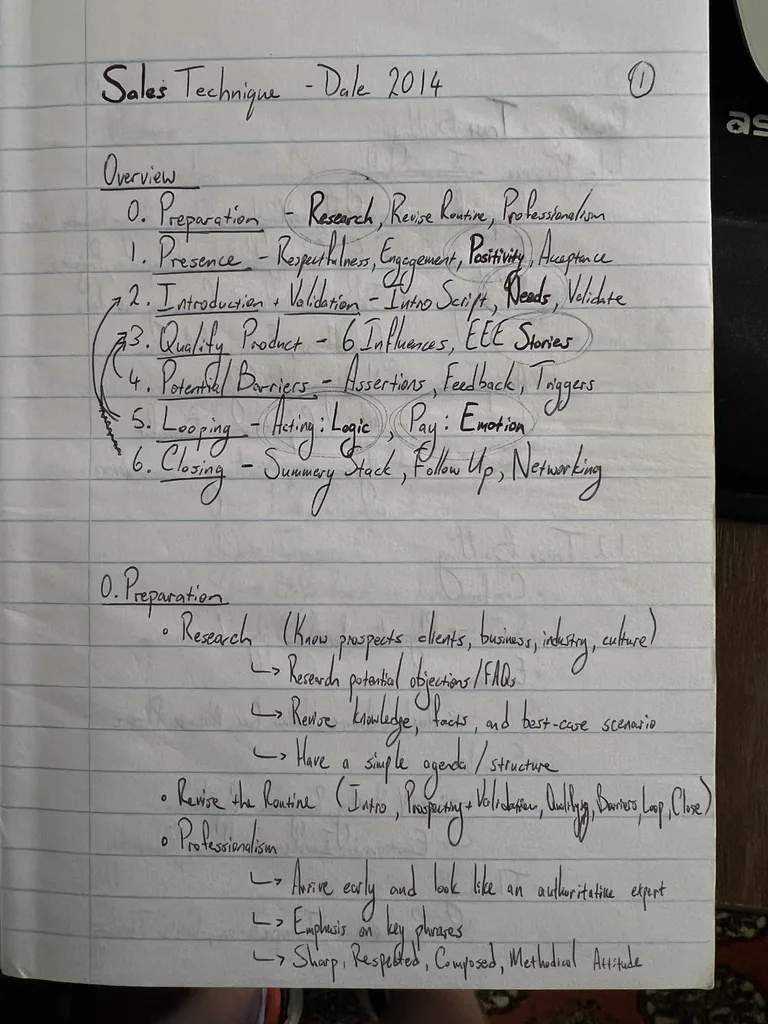
Preparation
Step zero happens before the meeting, which is why it’s zero. The page lists three parts: research, revise the routine, and professionalism.
- Know their clients, business, industry and culture.
- Research the likely objections and FAQs.
- Revise your knowledge, your facts and the best-case scenario.
- Have a simple agenda.
- Run through the routine: intro, prospecting and validation, qualifying, barriers, loop, close.
- Arrive early.
The last note is about attitude: sharp, respected, composed and methodical. Look like the authority in the room, and put the emphasis on the key phrases you prepared.
Presence
- Respectfulness
- Engagement
- Positivity
- Acceptance
This is how you behave once the meeting starts. Respect their time. Stay engaged, and listen more than you talk. Accept what they tell you, even when it’s not what you hoped to hear.
Positivity is the one I circled.
Introduction + Validation
Script your opening. The first minute is the one most likely to go wrong, so don’t improvise it.
Then ask about their needs, and keep asking until you could explain their problem back to them. That’s the validation: say their need back in their words and wait for the yes.
Intro scriptHi, I’m Deac. Here’s why I’m here.
NeedsWhat are you trying to solve?
…
ValidateSo what you need is ___. Right?
Right.
Qualify Product
Once you know the need, show how the product meets it. The page says “6 influences”: Robert Cialdini’s six principles of persuasion, from his 1984 book Influence.
- ReciprocityPeople return favours.
- CommitmentPeople stick with what they’ve already said yes to.
- Social proofPeople follow people like them.
- AuthorityPeople listen to experts.
- LikingPeople buy from people they like.
- ScarcityPeople want what’s running out.
Stories is circled. Tell them about a client like them: what they needed, what you did, and what happened.
Potential Barriers
Something always gets in the way. Price, timing, a boss who has to sign off.
- Assertions
- State the facts you prepared in step zero, plainly.
- Feedback
- Ask how it’s sounding as you go, so barriers come up while you can still answer them.
- Triggers
- Listen for the words and questions that show where they’re stuck.
On the page an arrow runs from here back to step 3. A barrier usually means the product isn’t qualified yet.
Looping
When a barrier comes up, loop back. Return to their needs (step 2) or re-qualify the product (step 3), then come forward again. Repeat until there’s nothing left in the way.
ActingLogic
PayEmotion
Both halves of the note are circled. Logic gets someone to act. Emotion gets them to pay. Each loop should give them both: a reason that adds up, and a reason to want it.
Closing
To close, stack up everything they’ve agreed to. Each need, and how you meet it, one on top of the other. By the top of the stack, saying yes is just agreeing with what they’ve already said.
- Need met
- Need met
- Barrier answered
- Yes
Then follow up. The last word on the page is networking: the people you meet in this deal are where the research for the next one starts. Which takes you back to step zero.