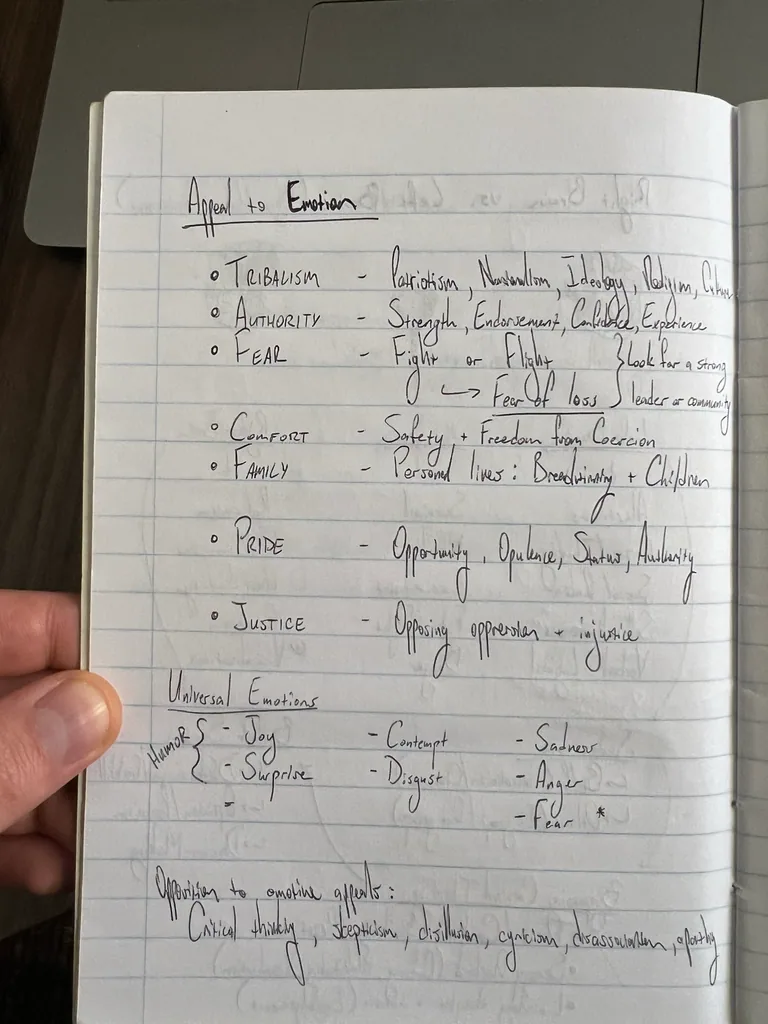
Tribalism
- Patriotism
- Nationalism
- Ideology
- Religion
- Culture
Us and them. The appeal tells you which group you belong to, and that the group wants this. Flags, team colours, scripture, “people like us”.
It’s first on the page, and fear points straight back to it. More on that in number 3.
Fear
Fear starts with fight or flight. On the page I drew an arrow from that down to fear of loss: your job, your savings, your way of life. That’s the version selling and politics reach for most.
- Fight or flight
- Fear of loss
- Look for a strong leader or community
Then a bracket around both: scared people look for a strong leader or a community. Which is authority and tribalism again. Fear rarely works alone. It sends people to the first two.
Comfort
Nothing bad happensSafety
Nobody pushes youFreedom
The page says “safety + freedom from coercion”. It’s the promise that you’ll be fine and nobody will force your hand. Insurance ads run on the first half. “No contract, cancel any time” runs on the second.
Family
- Personal lives
- Breadwinning
- Children
Personal lives: putting food on the table, and the kids. It’s hard to argue against someone who says they’re doing it for their children, which is why so many arguments start there.
Pride
- Opportunity
- Opulence
- Status
- Authority
The chance to get ahead, and to be seen getting ahead. Nice car, corner office, a title on the door.
Authority turns up twice on the page. Up in number 2 it’s someone you follow. Here it’s the authority you’d get to have.
Justice
Opposing oppression + injustice
Someone is being wronged, and you can do something about it. Every protest sign uses this one, and so do most campaign speeches. The other side usually does too.
Try it
Spot the appeal
Seven made-up slogans, one for each appeal. Guess first, then tap to check.
“Only three left at this price.”
Fear. Fear of loss. Wait and you miss out.
“You’ve earned this.”
Pride. Status. The reward is how it makes you look.
“Proudly South African.”
Tribalism. Buy it because people like you do.
“They’ve had it their way for long enough.”
Justice. Somebody is getting away with something.
“Recommended by dentists.”
Authority. Endorsement. Somebody who should know says yes.
“No contract. Cancel any time.”
Comfort. Freedom from coercion. Nobody can lock you in.
“Give them the start you never had.”
Family. Children, and the guilt of not providing.
Most real ads stack two or three. The dentist one is authority, but it’s also comfort.
Second half of the page
Universal emotions
Below the appeals I listed the seven emotions from Paul Ekman’s research: expressions that people from very different cultures read the same way.
- Joy
- Surprise
- Contempt
- Disgust
- Sadness
- Anger
- Fear
I bracketed joy and surprise as humour. A joke is a surprise you enjoy. There’s also an empty dash under surprise, which I never filled in.
Fear is on both lists, and it’s starred. It’s an appeal and a universal emotion.
NB: Ekman’s universality claim is contested. Lisa Feldman Barrett’s work argues we read faces through context and culture far more than he allowed. As a checklist for what an audience might feel, it still does the job.
Last line on the page
What stops it working
The page ends with the opposition to emotive appeals. Six words.
- Critical thinking
- Scepticism
- Disillusion
- Cynicism
- Disassociation
- Apathy
Read in order, the list gets darker. Critical thinking and scepticism weigh the appeal and decide. By cynicism, everything is assumed to be a trick. Apathy doesn’t weigh anything. It’s stopped feeling it.
If your audience has gone cynical, a louder appeal won’t fix it. My sales notes put it as logic to act, emotion to pay. Neither works on someone who’s stopped listening.