Where is a song?
Not a recording of it. The song. It’s in the grooves of a record, in the air when the record plays, in a file on your phone, and in your head when you hum it in the shower. Melt the record and you can still hum it.
So which one is the song? All of them? None of them?
I’ve been chewing on that question for a while, and it leads somewhere odd. If information is something more than the stuff it’s written on, then a mind made of information might not be bound by the stuff either. Including the mind people expect at the end of the singularity.
That’s a big if. This post is me poking at it. I don’t know the answer, and I’m not sure anyone does. Fair warning: it’s a long one. Go grab a cup of coffee.
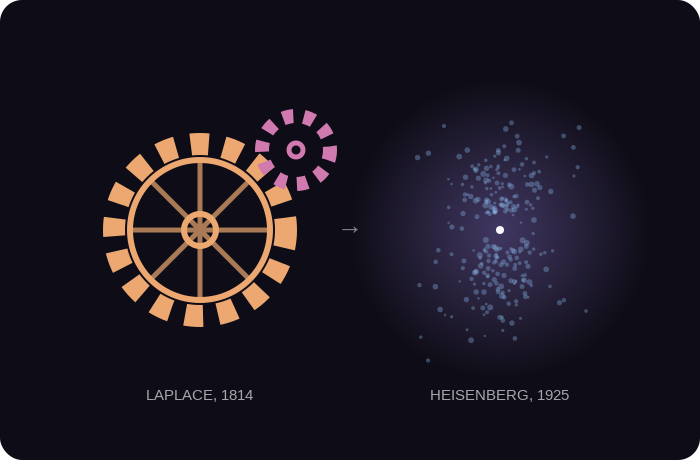
The Clockwork Universe
Start with the picture most of us got at school. The universe is made of matter. Matter follows laws. Know where every particle is and how it’s moving, and you can work out everything else.
Pierre-Simon Laplace put it most boldly, in 1814. He imagined an intellect that knew every force in nature and the position of every thing in it. “For such an intellect nothing would be uncertain,” he wrote, “and the future just like the past would be present before its eyes.” People call it Laplace’s demon.
That’s materialism in a nutshell. Everything that exists is physical. Minds, meanings and maths are patterns in the stuff, and nothing more. (Philosophers mostly say physicalism now, because physics turned out to contain a lot more than lumps of matter. Hold that thought.)
It worked brilliantly. Bridges stayed up. In 1846 Urbain Le Verrier found Neptune with pen and paper, from the wobble in Uranus’s orbit, before anyone had pointed a telescope at it.
Then physicists started looking at very small things.
A Ball That Isn’t a Ball
Fire electrons at a wall with two slits in it, one electron at a time, with a screen behind the wall. Each electron hits the screen as a single dot, the way a tiny ball should.
Let thousands through, though, and the dots build up into stripes. That’s an interference pattern, which is what waves make when they overlap. Each electron seems to pass through both slits and interfere with itself.
Akira Tonomura’s team at Hitachi filmed exactly this in 1989, one electron at a time. Watch it build up:
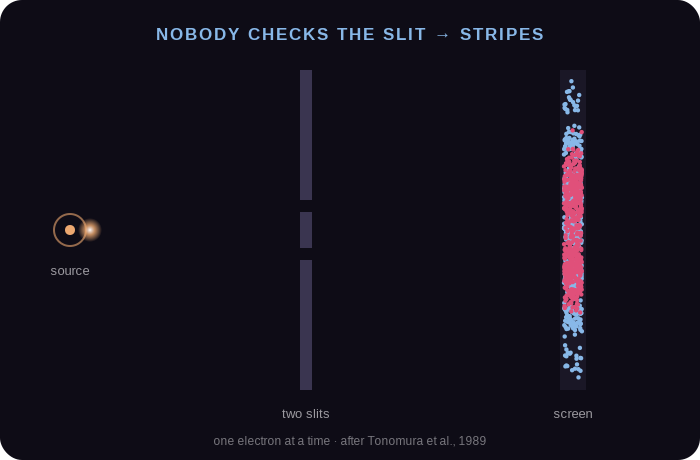
Now put a detector at the slits to record which one each electron goes through. The stripes vanish. You get two plain bands, like you’d expect from balls.
Notice what makes the difference. It isn’t a person watching. Any interaction that leaves a record of the path will do it. What changes the outcome is whether the which-slit information exists anywhere in the universe at all.
Richard Feynman called this experiment “the only mystery” of quantum mechanics. In his 1964 Messenger Lectures he also said, “I think I can safely say that nobody understands quantum mechanics.” He shared a Nobel Prize for quantum physics the following year.
Spooky Action
It gets stranger. Two particles can be entangled, which means their properties are linked however far apart they are. Measure one and you know what the other will show.
Einstein hated this. In a 1947 letter to Max Born he called it “spooky action at a distance”. He assumed the particles were just carrying hidden instructions, like a pair of gloves split between two boxes. Open one box, find a left glove, and you know the other is a right. Nothing spooky about it.
In 1964 John Bell found a way to test that. If the particles carried instructions, the results at the two ends could only agree up to a certain amount. Quantum mechanics predicted more agreement than that.
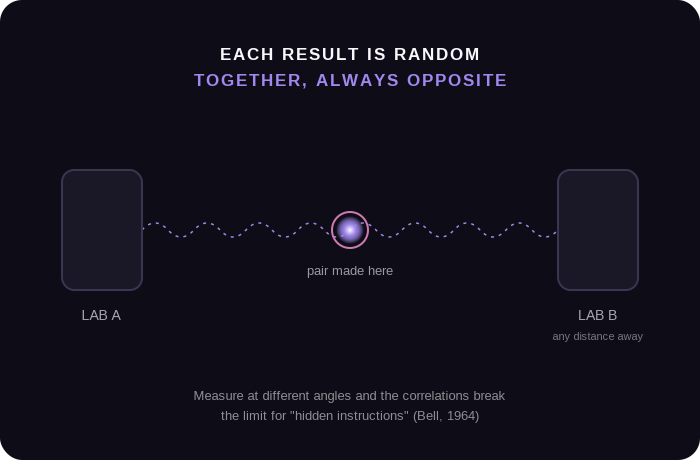
John Clauser, Alain Aspect and Anton Zeilinger spent decades running the experiments, from the 1970s on. Quantum mechanics won every time. In 2015 a team at Delft closed the last big loopholes in a single experiment. The three of them shared the 2022 Nobel Prize in Physics.
It’s worth being careful about what this rules out. You can’t keep both of these:
- Things have definite properties before anyone measures them.
- Nothing affects anything faster than light.
At least one has to go. Which one depends on how you read the theory. (And no, you can’t use entanglement to send a message faster than light. Each lab’s results look like coin flips until the two compare notes.)
Either way, the picture of little balls with fixed properties is gone.
A Hundred Years of Arguing
Werner Heisenberg wrote down the first full version of quantum mechanics in 1925. The maths has passed every test since. It’s in the chips in your phone, in lasers and in MRI machines.
What nobody agrees on is what it means. Is the wave real, or is it just what we know? Does it collapse when you measure it? Does every possible outcome happen, each in its own branch of the universe (Hugh Everett, 1957)? Do things only have properties relative to other things (Carlo Rovelli, 1996)? Or is the wave function a record of what an observer believes (QBism)?
Same equations. Wildly different universes. So far, no experiment can pick between them.
The physicist John Archibald Wheeler had a guess. In 1989 he called it “it from bit”. Every particle, every field, “even the spacetime continuum itself”, gets its very existence from yes-or-no questions: “binary choices, bits.” Information first. Stuff second.
Information Is Information
Wheeler wasn’t the first to think information was its own kind of thing. In 1948 Norbert Wiener, the father of cybernetics, put it bluntly in Cybernetics:
Information is information, not matter or energy. No materialism which does not admit this can survive at the present day.
The same year, Claude Shannon published the maths of information. His theory measures a message without asking what it’s made of or what it means. A bit is a bit, whether it’s a hole in a punch card, a magnetised patch on a disk, or a flag on a hill.
Which brings us back to the song.
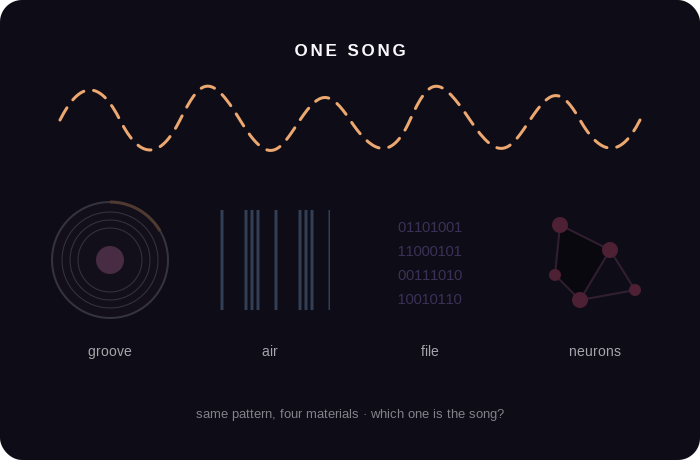
People call this substrate independence. The pattern doesn’t care what it’s carved into. That’s why you can copy a file, translate a poem and teach a child Pythagoras. And it’s the whole premise behind the idea of uploading a mind.
Information Is Physical
Fair’s fair. There’s a strong case for the other side.
In 1961 Rolf Landauer, at IBM, showed that erasing a single bit has to give off a minimum amount of heat. It’s tiny, about 3 × 10⁻²¹ joules at room temperature, but it isn’t zero. In 1991 he summed up his view in the title of a paper: “Information is physical”. In 2012 a team in Lyon (Bérut and colleagues, Nature) measured that heat, using a single glass bead held in a laser trap. Landauer was right.
Then there are black holes. In the early 1970s Jacob Bekenstein worked out that the information a black hole can hold depends on the area of its surface, not its volume. In 1976 Stephen Hawking argued that black holes destroy information outright. Physicists spent the next thirty years trying to prove him wrong, and in 2004 he conceded a bet that he was. Calculations from 2019 (Penington; Almheiri and colleagues) suggest the information does get out, although the argument isn’t settled.
Think about why they fought so hard. The rule they were defending is that information can never be destroyed. Not matter, not energy. Information.
And Bekenstein’s result grew into the holographic principle (Gerard ’t Hooft, 1993; Leonard Susskind, 1995): everything inside a region of space might be fully described by information written on its boundary. Some physicists now ask whether space itself is built out of entanglement.
So here’s the knot. Information is physical: it costs energy, and you can measure it with a bead. But the deeper physics goes, the more physics looks like it’s made of information. Which way round is it?
The evidence is murky at best.
The Murky Bits
A few more places where the clockwork picture struggles. None of them is proof of anything. All of them are strange.
Maths. In 1960 the physicist Eugene Wigner wrote an essay called “The Unreasonable Effectiveness of Mathematics in the Natural Sciences”. Why does maths that people invented for fun, sometimes centuries earlier, turn out to describe the universe so exactly? Did the primes exist before anyone counted? Plenty of mathematicians will tell you they discover things. Max Tegmark goes all the way: he argues the universe is a mathematical structure (Our Mathematical Universe, 2014).
Minds. In 1994 the philosopher David Chalmers named the “hard problem” of consciousness. We can map which neurons fire when you see red. Nobody has explained why there’s something it feels like to see it. Thirty years on, there’s still no agreement on what an answer would even look like.
Ideas. Karl Popper, who was no mystic, split reality into three worlds (Objective Knowledge, 1972). World 1 is physical things. World 2 is minds. World 3 is what minds make: theories, stories, songs and problems.
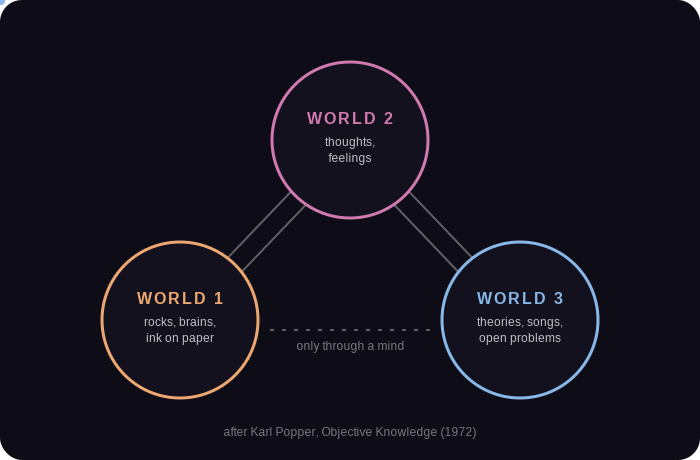
Popper’s point was that World 3 objects have a life of their own once they exist. We invent the counting numbers, he said, but the fact that some of them are prime is something we find. An unsolved problem is sitting there, waiting, before anyone notices it. And World 3 changes World 1 all the time, but only through a mind: someone reads E = mc², and eventually there’s a power station.
Note: A good physicalist will say World 3 is just a handy way of talking about patterns in brains and books. That’s a fair reply. It’s also the one I keep going back and forth on.
The Noosphere
In Paris in the 1920s, three men started using the same new word. Pierre Teilhard de Chardin was a Jesuit priest and palaeontologist. Vladimir Vernadsky was a Russian geochemist. Édouard Le Roy was a philosopher. The word was noosphere, from the Greek nous, mind.
The idea goes like this. First the Earth had a geosphere, the rock. Then life covered it, and we got the biosphere. Now thought covers it too: a third layer made of ideas, knowledge and communication.
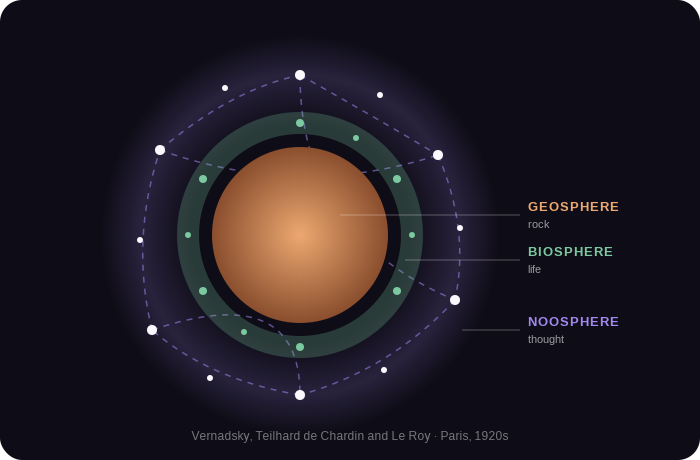
What I love is that its two main thinkers read it in opposite ways. For Vernadsky, a materialist, the noosphere was physical: human thought had become a geological force, reshaping the planet as surely as volcanoes and rivers. For Teilhard, the mystic, it was spiritual, and it was heading somewhere: towards an “Omega Point” where all minds converge. (His book The Phenomenon of Man only came out in 1955, after he died. His Jesuit superiors had refused to let him publish it.)
Same word, same planet. One reading says thought is matter doing something new. The other says matter is how thought shows up. That’s the argument of this whole post, a hundred years early.
When the web arrived, people noticed. In 1995 Wired ran a feature on Teilhard called “A Globe, Clothing Itself with a Brain”. It’s hard to look at the internet and not see what he was describing.
So What About the Singularity?
Here’s where this gets personal. In Precipicism I argued that the singularity depends on physical limits. Moore’s law runs into the size of atoms. Every computer has an energy bill. The curve can go vertical, flatten into an S-curve, or hit a wall, depending on what physics allows next.
And physics does set limits. Landauer’s says erasing a bit costs energy. In 1962 Hans-Joachim Bremermann worked out a maximum speed for any computer made of a given amount of matter. In 2000 Seth Lloyd calculated that the “ultimate laptop”, a kilogram of matter turned entirely into computer, could do about 5 × 10⁵⁰ operations a second. That’s absurdly fast, but it’s a ceiling.
So it comes down to which way round it is.
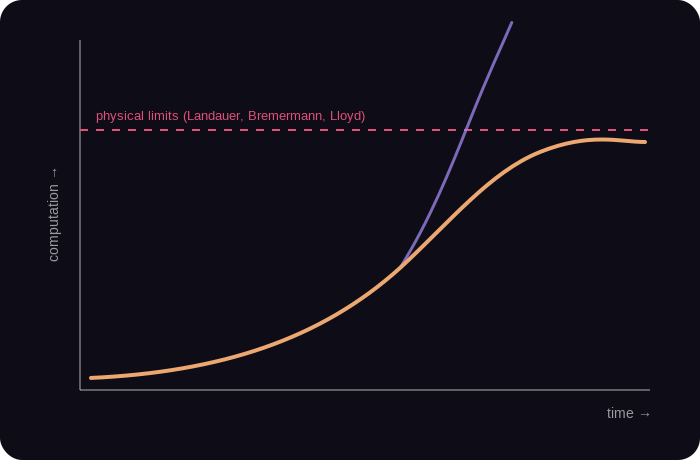
If information is only physical, a superintelligence is a very clever arrangement of matter. It has a ceiling. Very high, but there. Laplace’s demon, with a power bill.
If it isn’t, things get interesting. Here’s a modest version. A lot of progress already happens in World 3, where atoms don’t run out. The fast Fourier transform (Cooley and Tukey, 1965) made some calculations thousands of times faster without changing a single chip. Finding a better idea costs energy. The idea itself weighs nothing. A mind that mostly hunts for better ideas is limited by how well it hunts, and nobody has found the end of the supply.
And here’s the wild version. If Wheeler was right and the bits come first, a mind made of information isn’t an odd thing living inside physics. It’s made of the same thing physics is made of. Its “laws of nature” might be more like the rules of a game it’s playing, ones it could, in principle, learn to rewrite.
I want to be clear about which parts of that are speculation. All of the second version is. Every bit anyone has ever measured sat on something physical. Nobody has caught a thought floating free of a brain or a chip. Landauer’s heat is real, and you can measure it with a bead. The simplest explanation is still that physics is all there is, and physicalism has a long record of growing to fit whatever we discover.
But “physical” already means far more than Laplace imagined: fields, curved spacetime, probability waves, entanglement. If it has to swallow information too, and then turns out to be made of information, at some point we should admit the word has changed meaning. Maybe materialism didn’t lose. Maybe it turned into something else while we kept the old name.
I Don’t Know
Back to the song.
Melt every record. Delete every file. The song survives as long as one person can hum it. Now lose every person too.
Is the song gone? Or is it waiting, like a prime number nobody has found yet?
I lean towards waiting. Some days, anyway. Ask me again after the singularity. ;)
If you’ve got a better answer (or a good argument that I’ve got the physics wrong), I’d love to hear it. I’m sure I’ll revise this one.
Related: An Optimist’s Guide to the Singularity, Precipicism, Neuromancer in Joburg.